There are no ads on the HIGH SPEED newsletter, and there never will be. (No A.I. slop, either!) It's entirely supported by readers like you. I publish it on a platform called Ghost, because I don't like the way Substack channels reader money to Nazis, fascists, white supremacists, and the likes of Andrew Tate. Unlike Substack, though, Ghost charges an annual fee. I want to keep HIGH SPEED going, but to pay that fee and continue doing the research, travel, and writing necessary to keep this up week in, week out, I need your support. I hope you'll consider becoming not just a free subscriber, but a paid member; you can follow the link to the sign-up portal here. And to all those who have already helped out by becoming a Rail Pass Holder or Founding Member, thank you!
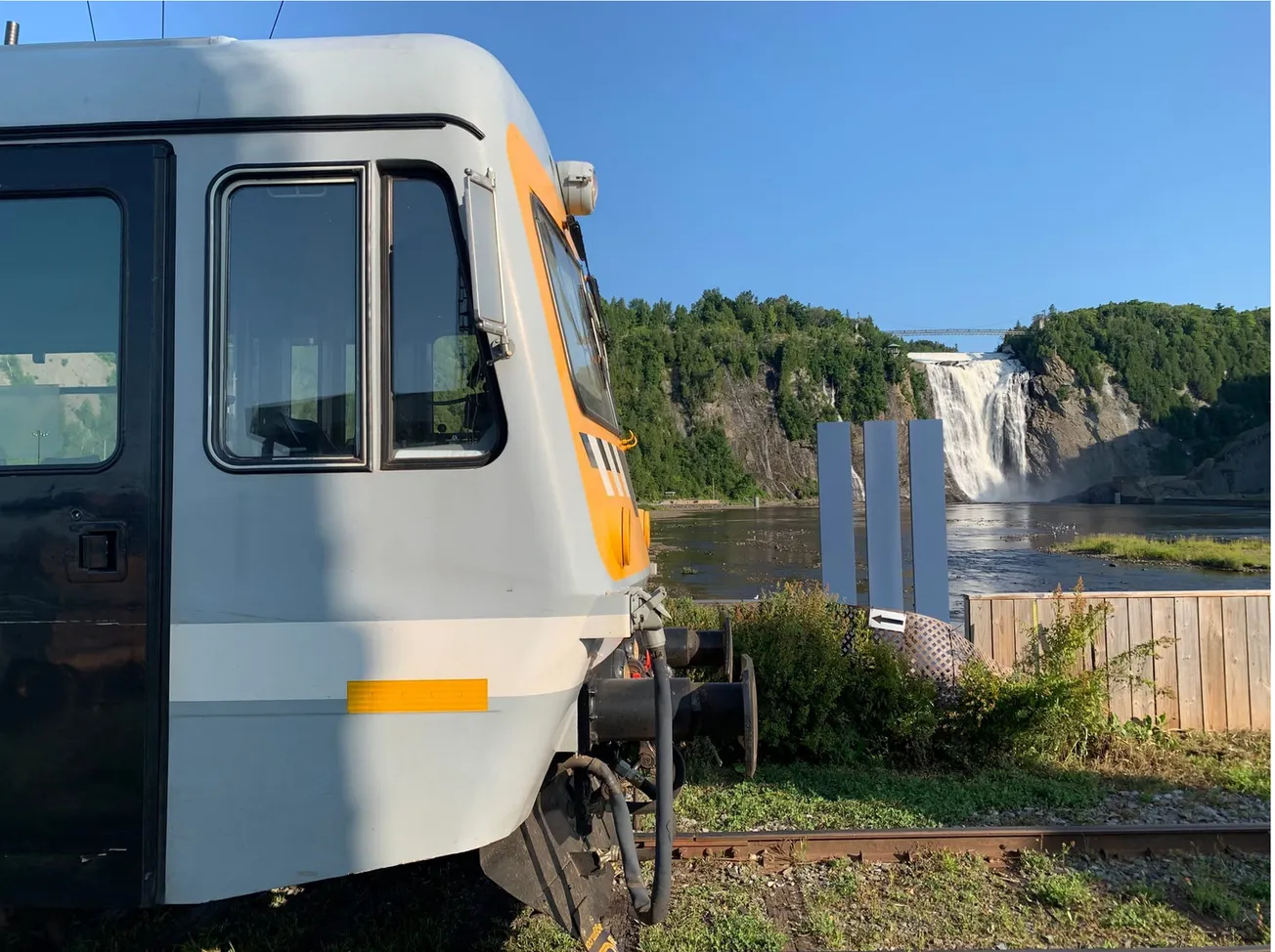
// My first reaction, as my teenage son Desmond and I boarded the Train de Charlevoix, was the slightest sense of disappointment. Not with the surroundings, which, on this blue-sky summer morning, suggested a vintage hand-tinted picture postcard. A pair of trains, clad in a dashing livery of grey, black, and yellow, awaited the day’s passengers on a stretch of track paralleling a churning wall of white water, where a tributary of the St. Lawrence River spills over a cliffside north of Quebec City. Ten storeys higher than Niagara, the Montmorency Falls are stunning all year-round, though especially in the winter, when they congeal into an undulating ice sculpture that seeps clouds of ice-crystal-bedazzled steam.
It wasn’t the scenery, but the rolling stock that gave me pause. In 2023, the Train de Charlevoix, a non-profit organization that runs Canada’s only excursion train outside the Rocky Mountains, made headlines when it brought in a hydrogen-powered trainset, the Coradia iLint, from Germany. The idea was that a train carrying fuel cells would be a perfect fit on this century-old railway, whose route along a sinuous riverine coastline makes it a challenge to fully electrify. But when the pilot-project ended after the summer of 2023, the railway deemed the Alstom-made train too costly for its budget. (The Train de Charlevoix made headlines again in 2025, when financial problems caused it to shut down altogether. I'm happy to report the train is back on the tracks again this year, with service from June 5 to Nov. 1, 2026.)
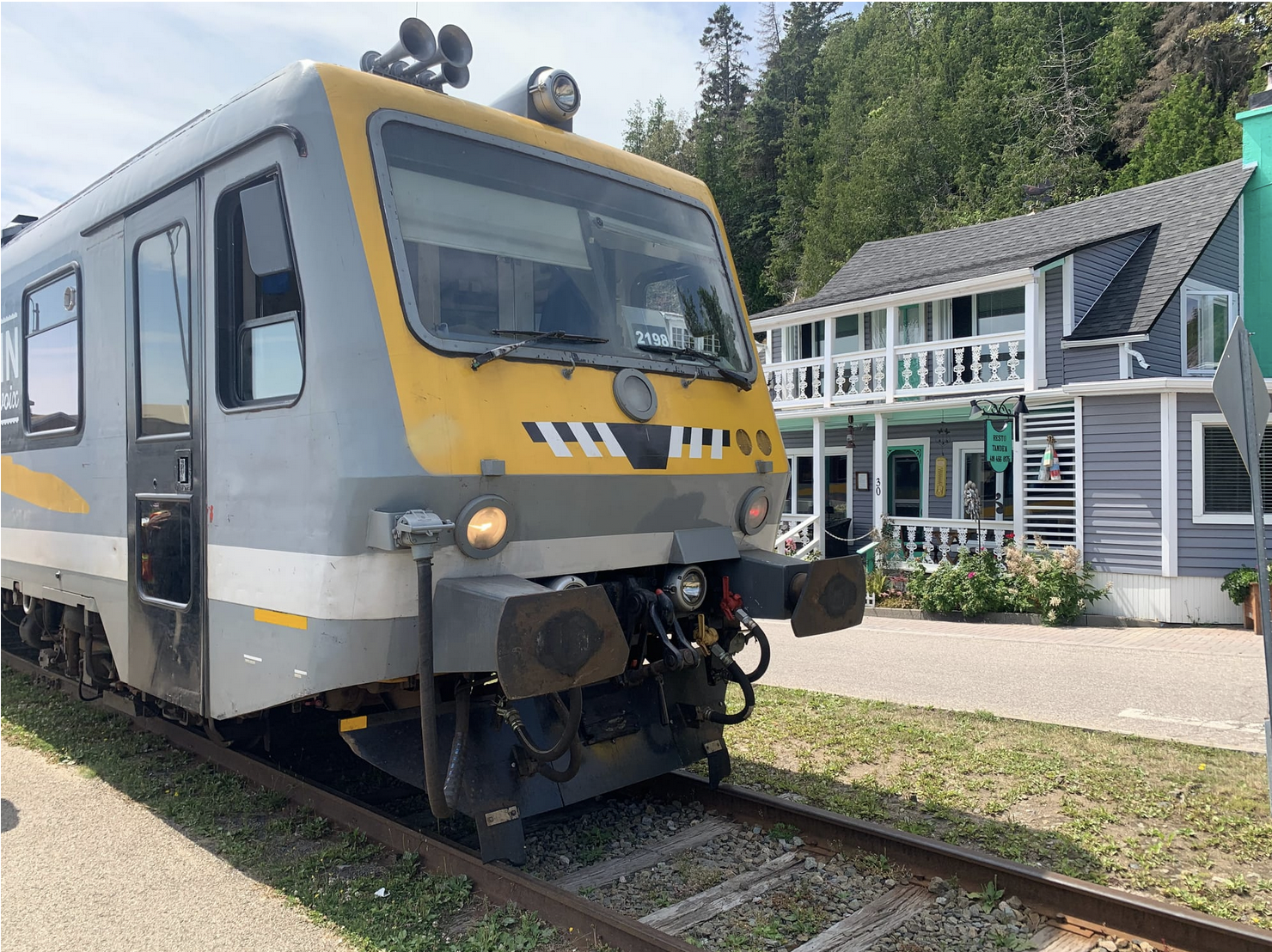
The train we’d be riding today, one of four owned by the railway, was also German, but this was no bleeding-edge piece of rail tech: it was a self-propelled diesel multiple unit—with a driver’s cab in the passenger coach—of 1980s vintage, originally built by Deutsche Bahn for suburban service. A form of transport North American railfans, who tend to be fonder of heavy-duty locomotives, disparagingly call a “doodlebug.” This one was slightly down-at-heel, with faded upholstery and stickers that still read “Please do not address our driver!” in the original German.
I took heart by recalling one of Paul Theroux’s observations. “Truly,” the great literary rail-rider observed, “the worst trains take one across the best landscapes.” Though we lived in Quebec, we had yet to really explore the north shore of the St. Lawrence, whose landscape is ranked among the most spectacular in eastern Canada.
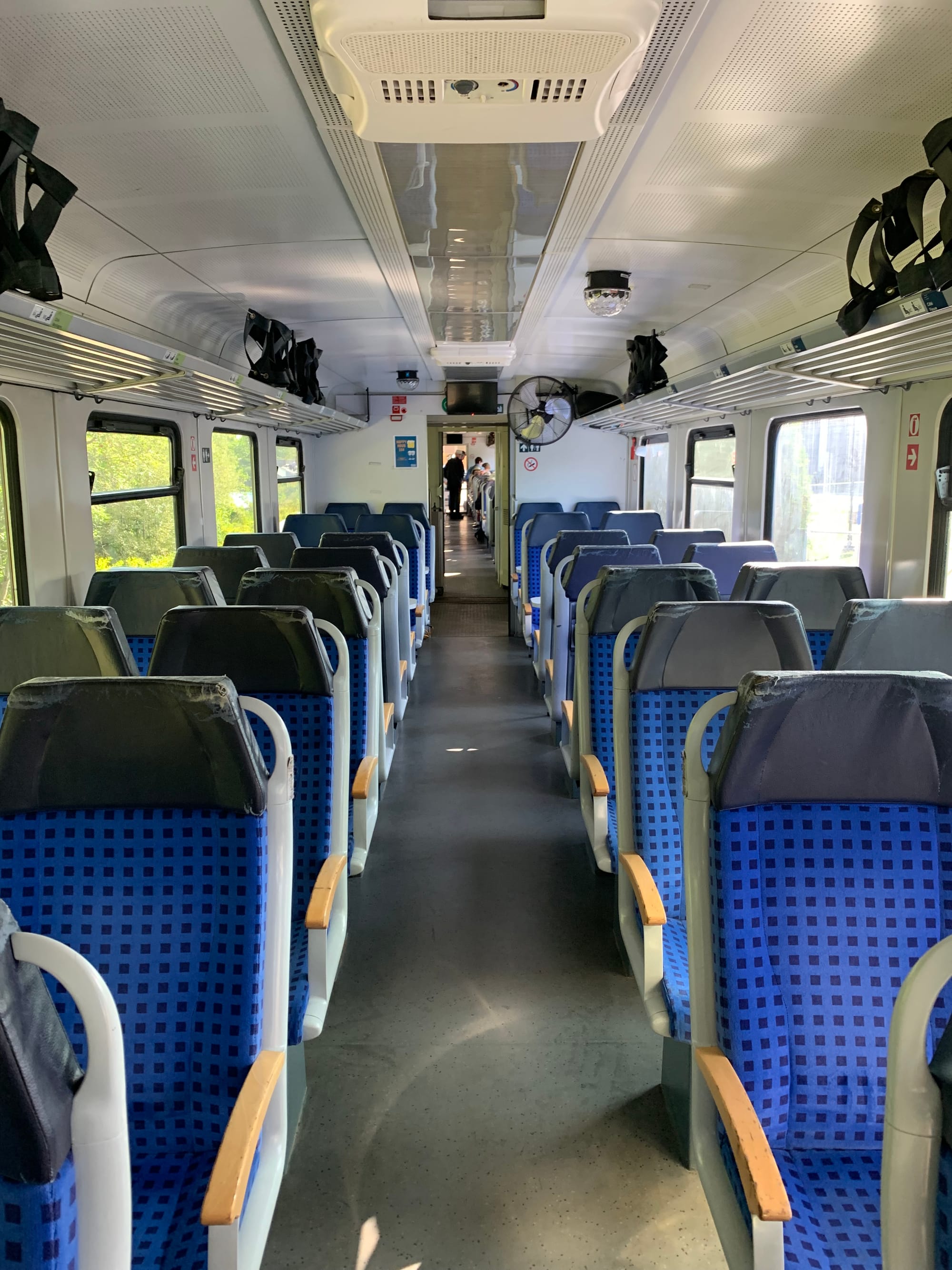
As we were guided to our assigned seats by a young conductor in a blue denim shirt and black slacks, I pointed out to Desmond that there was one advantage of riding a forty-year-old train: we’d actually be able to take in the view. The previous day, we’d made the three-hour rail journey from our hometown of Montreal to Quebec City. Via Rail, Canada’s national passenger rail service, has lately introduced trains capable of running at 200 kilometers (125 miles) an hour on some eastern routes. (In practise, sharing the tracks with freight trains means they never exceed 160 kilometers [99 miles] an hour; true high-speed rail continues to elude Canada; I write more about riding trains in the Windsor to Quebec City corridor in this post.) The new Siemens-made trains are built like jetliners—metal cylinders with narrow cabin windows—which makes it difficult to relish the scenery. The Train de Charlevoix may top out at a mere 48 kilometers (30 miles) an hour, but its non-aerodynamic styling allows for high ceilings and panorama-friendly windows.
Besides, when the craggy cliffs of the foothills of the Laurentian Mountains are to port, and the silvery expanse of the world’s largest estuary to starboard, slow is clearly better. Our excursion started with the keening blast of rooftop whistles. We swayed by the flashing red lights at level crossings, passing billboards for snack bars selling lobster rolls, rows of ripening maize on riverfront strips of farmland, and the back porches of clapboard wooden bungalows.
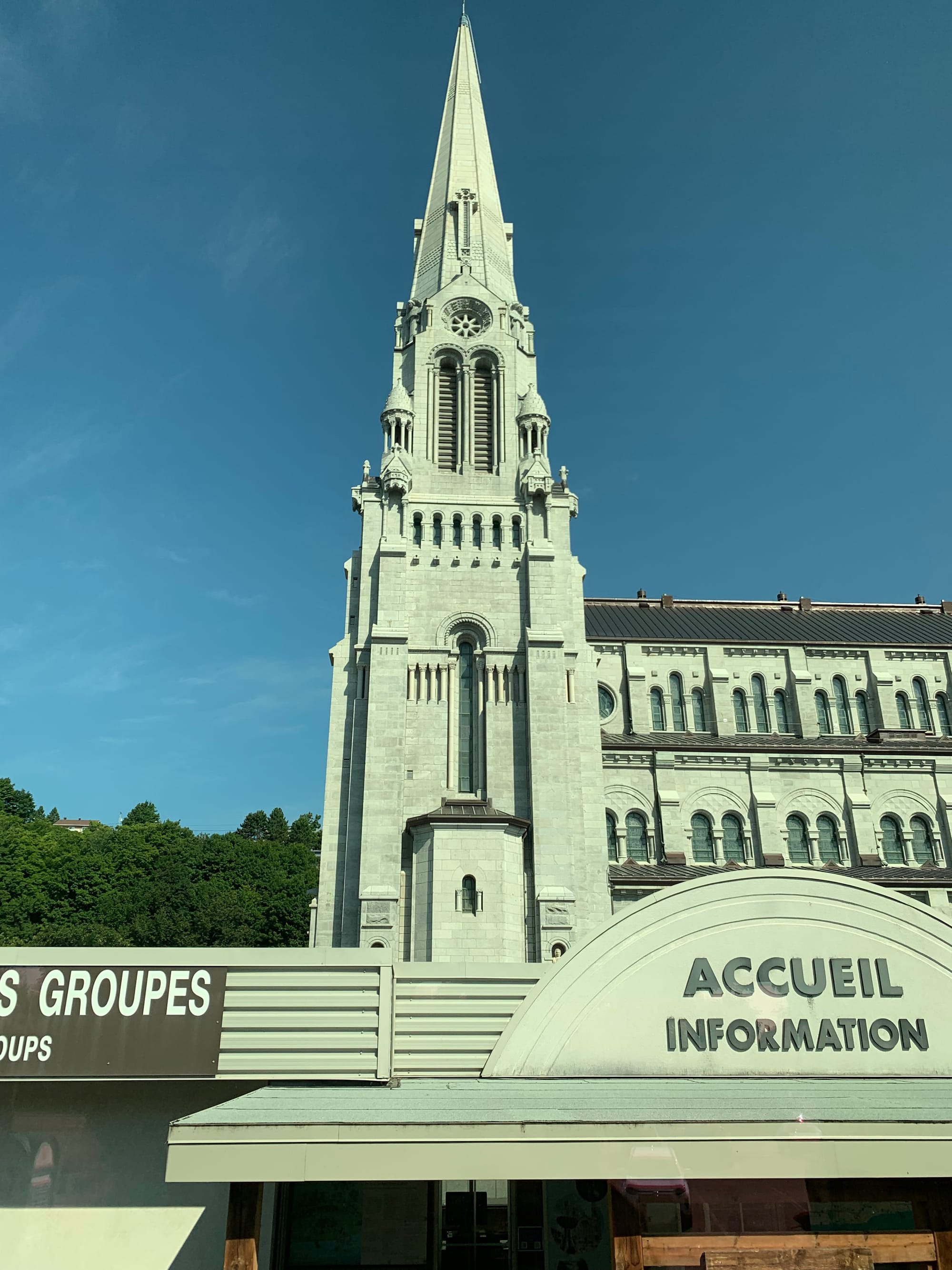
As the train approached Ste-Anne-de-Beaupré, it slowed to the pace of a jog, allowing us an up-from-under view of the towering silver steeples of the Basilica. In the seventeenth century, Breton sailors, having survived a mid-river tempest, raised a shrine here to the patron saint of mariners. During construction of a new church, in 1922, one of the builders was apparently delivered from rheumatism; the entrance is now bracketed by towers of the crutches and wheelchairs shed by pilgrims Ste-Anne is said to have cured of their ailments.
Without the Basilica, the railway wouldn’t exist. A steam train first brought churchgoers here from a suburb of Quebec City in 1889. A decade later, this part of the route was electrified, using energy generated by Montmorency Falls. Then the ambitious Rodolphe Forget, whose success with the Montreal’s tramway system made him one of the first French-Canadian millionaires, was granted a charter to extend the tracks to Quebec’s remote Charlevoix region. Forget went to Europe to secure financing—cancelling his return passage to Canada, on the maiden voyage of The Titanic at the last minute—and the first train of his Quebec & Saguenay Railway reached the village of La Malbaie, its modern-day terminus, in 1919.
As the tracks veered coastwards, parting company with the area’s only highway, it became obvious why building this railway was such a feat. We crossed the wetlands at the Cap Tourmente wildlife preserve, where storks and herons stilt-walked for prey, and raised platforms offered a view of the main migration route of snow geese. Like so many pioneering North American railways, this one followed the curvaceous path of least resistance, and soon we were skirting the sheer faces of the granite capes that crowd up to the tideline. I was happy to see the bars on our devices dwindle to nought; with no hope of on-screen entertainment, Desmond began to scan the surface of the estuary, here wide enough to pass for one of the Great Lakes, for the spouts of minke and beluga whales, which follow their prey far upstream.
The railway served as a solitary lifeline for residents of such villages as Les Éboulements and St-Joseph-de-la-Rive until 1977, the year Canadian National, which had taken over Forget’s useful but unprofitable enterprise, ended regular passenger service. Since then, the trains have been kept running by Charlevoix native Daniel Gauthier, co-founder of the world-beating Cirque de Soleil. Over the years, Le Massif has run a motley assortment of excursion trains, including double-decker coaches borrowed from the commuter rail networks of Illinois and Ontario.
As we pulled into Baie St-Paul—the town where Gauthier co-founded the Cirque de Soleil—Desmond swivelled to snap photos of the sheep, goats, chickens and cows at La Ferme, a working model farm located trackside. The town, with a population of just 7,000, manages to support twenty art galleries; the train station is part of a complex that includes Le Germain Charlevoix, a very modern destination hotel whose restaurants showcase the region’s excellent cuisine.
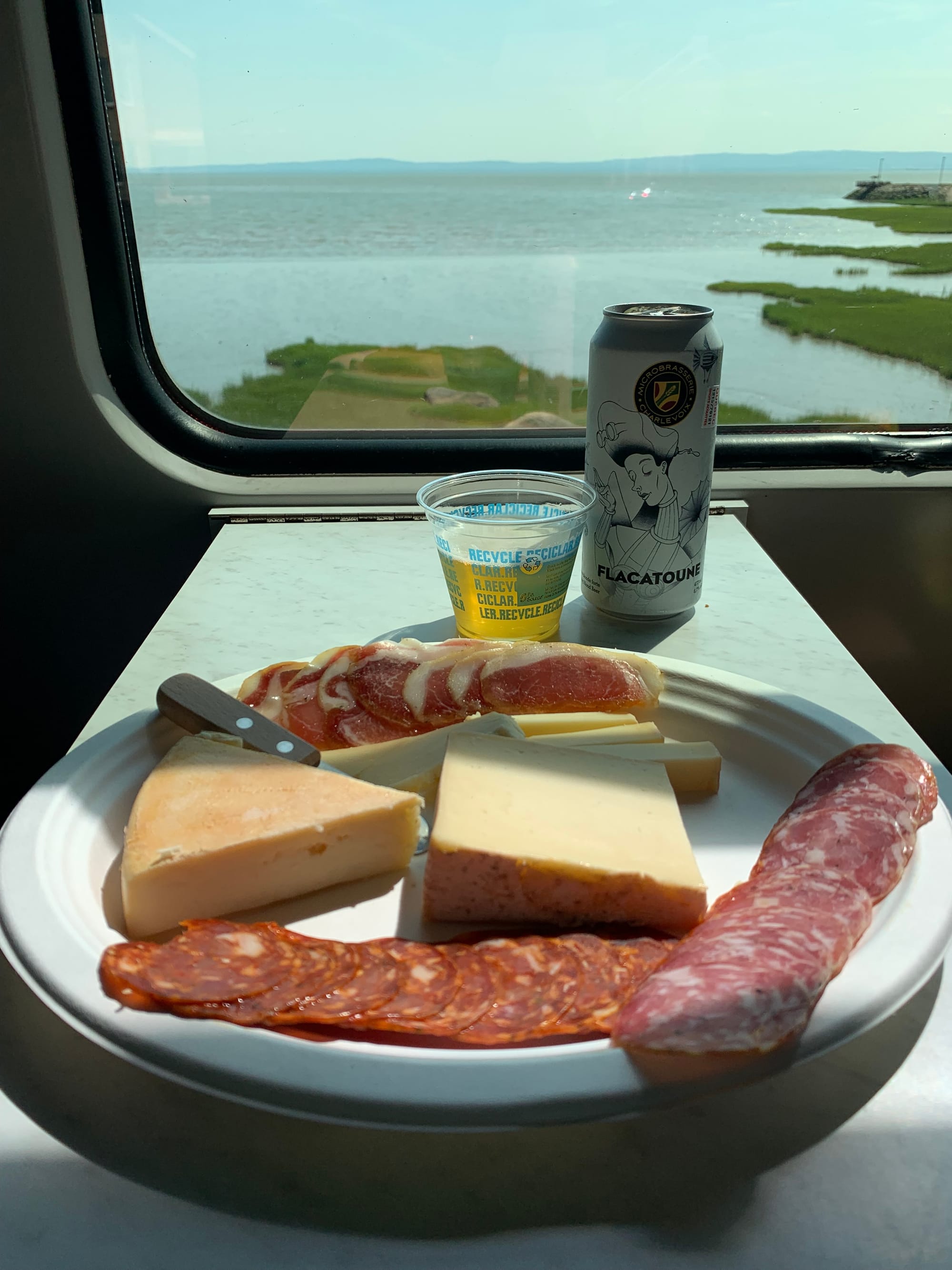
Back on the train, the conductor brought a selection of local charcuterie and cheeses to our table; we agreed the flavorful, unpasteurized Migneron de Charlevoix was the best of the lot. (There were also sweet and salty snacks for Desmond, and a much appreciated can of Flacatoune beer, from the Charlevoix microbrewery, for Dad.) As the tracks paralleled the coastline of the Isle-aux-Coudres, an island favored by cyclists and served by a free ferry, the landscape became really rugged. On the river side of the train, the tide had receded, revealing massive smooth-topped boulders. I spotted a pair of deer who had come down to the water to browse at the edge of vivid green expanses of seaweed.
The conductor returned to warn us that we were about to enter one of the railway’s two tunnels, dug in part, she told us, by German internees during the First World War. While we pondered this grim notion, the lights went off, and the coach lit up with the dancing lights of electronic disco balls suspended from the ceiling. For the length of the tunnel, the train became a rolling Studio 54, offering, if nothing else, evidence of Quebec’s vaunted joie de vivre.
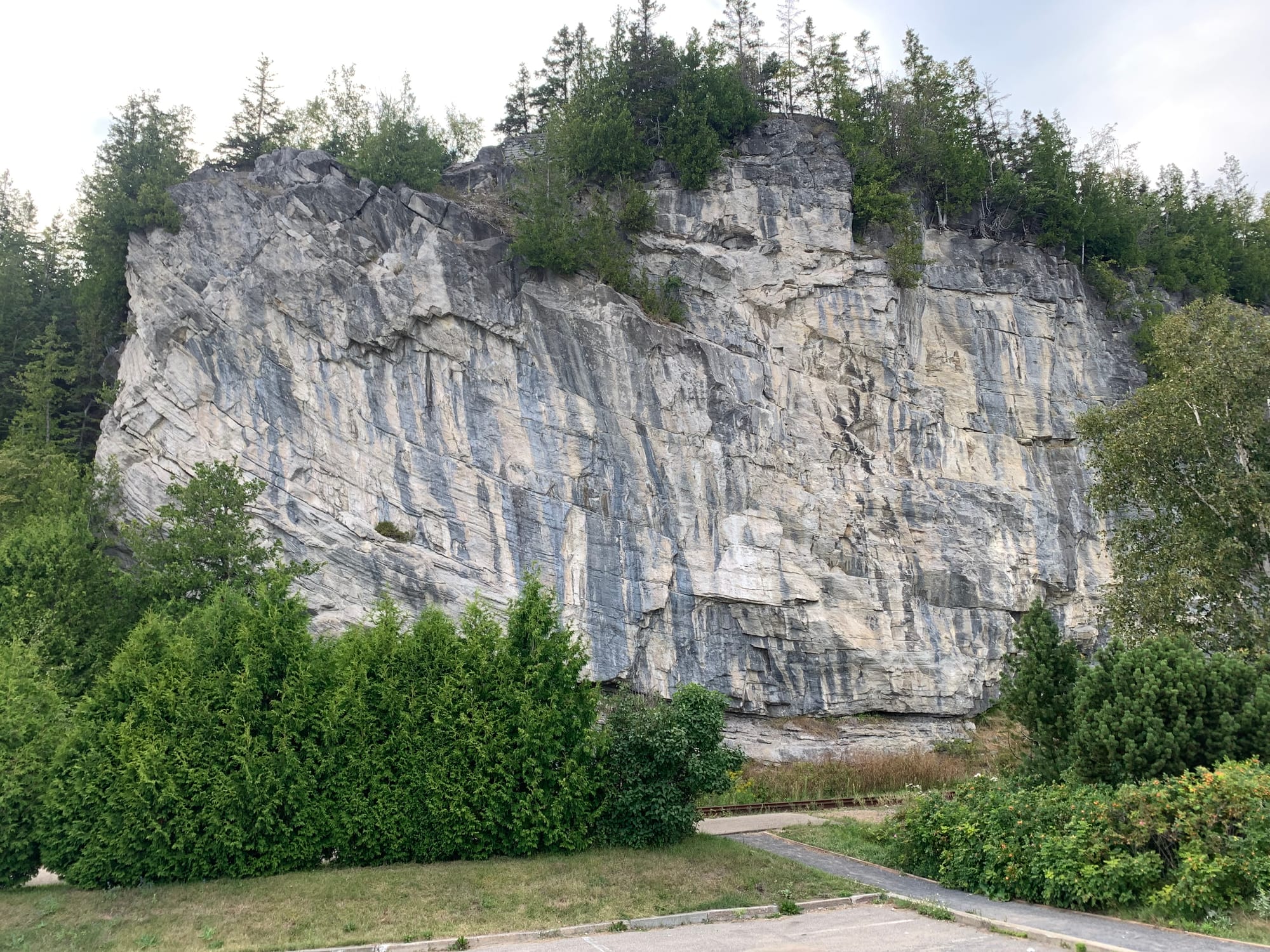
Rounding a cape, whistles blaring, we rolled into our last stop, La Malbaie. Known as Murray Bay for much of the twentieth century, it was the mooring point for the steamships of the Richelieu & Ontario Navigation Company. The line’s Victorian-era “white ships” were ornately decorated, with cabins for up to 300 passengers, bringing the elite from Toronto, Montreal and eastern U.S. cities to its resorts and castle hotels. (President William Howard Taft was a summer regular at the Murray Bay Golf Club, which remains the oldest continuously operating course in North America.) A short shuttle-bus ride took us to our home for the night, the Manoir Richelieu.
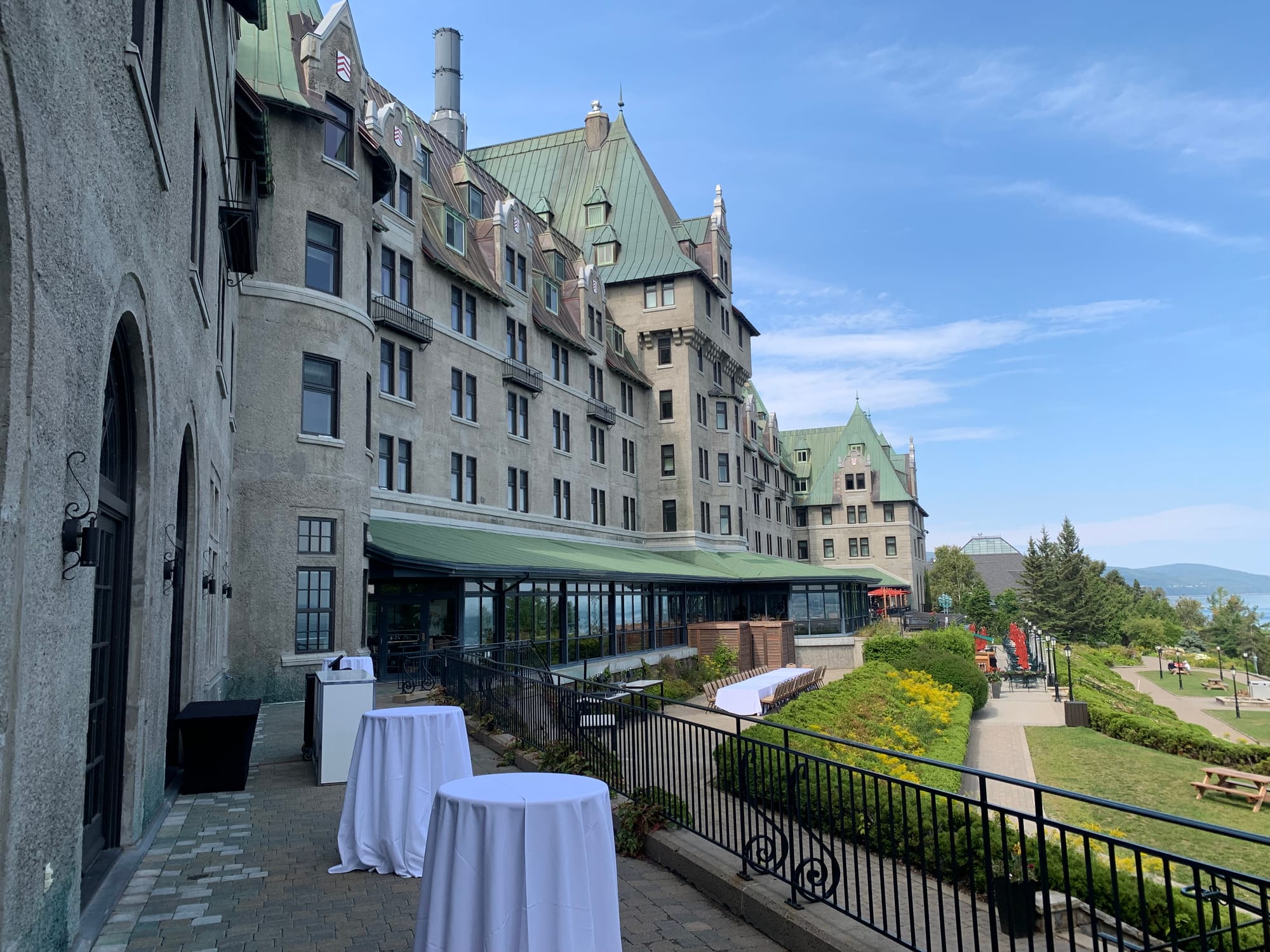
The Manoir was the brainchild of the entrepreneur behind the railway, who also became the president of the steamship company. Forget, who had cheated fate on The Titanic, died in 1919, a few months before his railway reached La Malbaie. His all-wood palace-hotel burnt to the ground nine years later, but it was quickly rebuilt, this time in concrete, and at such a scale that, when it opened, it was the largest summer hotel in North America. Now it is managed by the Fairmont chain, which oversees most of Canada’s great railway hotels, including the Banff Springs and the Château Laurier, whose architect also built the Manoir. Desmond inspected the beehives that produce the honey served for breakfast, splashed in the outdoor swimming pools, and participated in an outdoor marshmallow roast. Then he discovered the tennis courts, mini-golf, and games room (ping-pong, shuffleboard, and God help us, PlayStation terminals), which kept him occupied for the rest of our stay.
For my part, I wandered the hotel absorbing a bygone era’s vision of splendour, gazing over the Norman turrets and angular cornices that pierce the verdigris of the copper roof, and strolling ballrooms hung with cringe-inducing canvases of explorers and grandes dames bestowing the light of knowledge on indigenous people. The following morning, Desmond and I would shoulder our backpacks, and walk down linked wooden staircases back to the station, to anticipate the clangorous arrival of the Train de Charlevoix, and a long day of travel home to Montreal.
Tonight, though, we savoured our role as guests in a New World castle, that rose, improbably but wonderfully, at the end of a railway line through the meadows, crags, and northern woods.
THE LATEST IN PASSENGER RAIL NEWS
Zone 3: The Americas
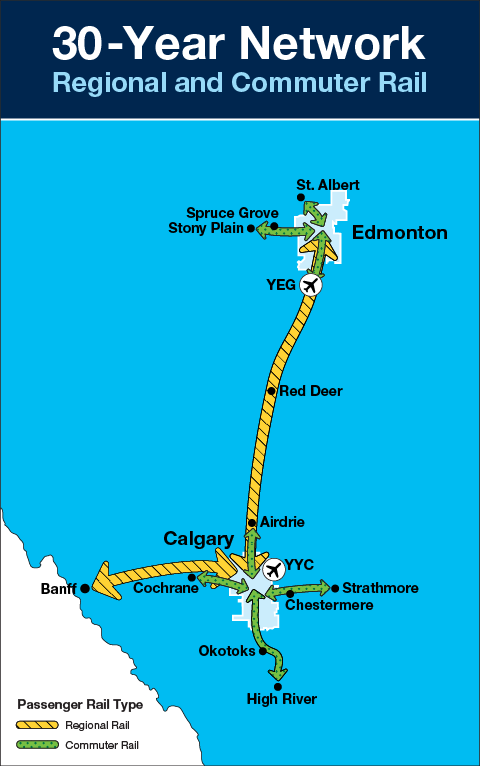
The province of Alberta is in the news these days because of its secessionist movement, and an upcoming referendum on a referendum about leaving Canada for good. (I have a lot to say about this, but, in the interests of concision, I'm biting my tongue quite hard right now.) At the same time, Premier Danielle Smith has just announced a Passenger Rail Master Plan, which "includes plans for a high-speed train of up to 320 km/h between Edmonton and Calgary via Red Deer, with up to one train per hour in the key corridor." The best-case scenario, I figure, is that Alberta might compete with Quebec and Ontario to be the first to complete Canada's first high-speed rail line. (Here's the link.)