There are no ads on the HIGH SPEED newsletter, and there never will be. (No A.I. slop, either!) It's entirely supported by readers like you. I publish it on a platform called Ghost, because I don't like the way Substack channels reader money to Nazis, fascists, white supremacists, and the likes of Andrew Tate. Unlike Substack, though, Ghost charges an annual fee. I want to keep HIGH SPEED going, but to pay that fee and continue doing the research, travel, and writing necessary to keep this up week in, week out, I need your support. I hope you'll consider becoming not just a free subscriber, but a paid member; you can follow the link to the sign-up portal here. And to all those who have already helped out by becoming a Rail Pass Holder or Founding Member, thank you!
Note: I'm about to go on vacation, so for the next three weeks, these dispatches will appear at a more...leisurely...pace. On the plus side, I will be riding lots of trains, buses, funiculars and metros in Europe; you can check out my progress @taras.rides.trains on Insta and here on Bluesky.
// I recently spent a week in Toronto, the city where I was born. I'm in the midst of exploring Canada's passenger rail network for a new book, and I needed a place to drop my bags; a friend's apartment in Parkdale happened to be free. (The neighbourhood turns out to be in the heart of Little Tibet. Who knew there were so many different kinds of momos?) Naturally, I took a straphanger's approach to the Big Smoke, and made sure to load up my Presto card before arriving on a VIA Rail train from Montreal. The King car (for non-Torontonians: the east-west King Street streetcar) was my workhorse, but I also went out of my way to use other parts of Toronto's transit network.
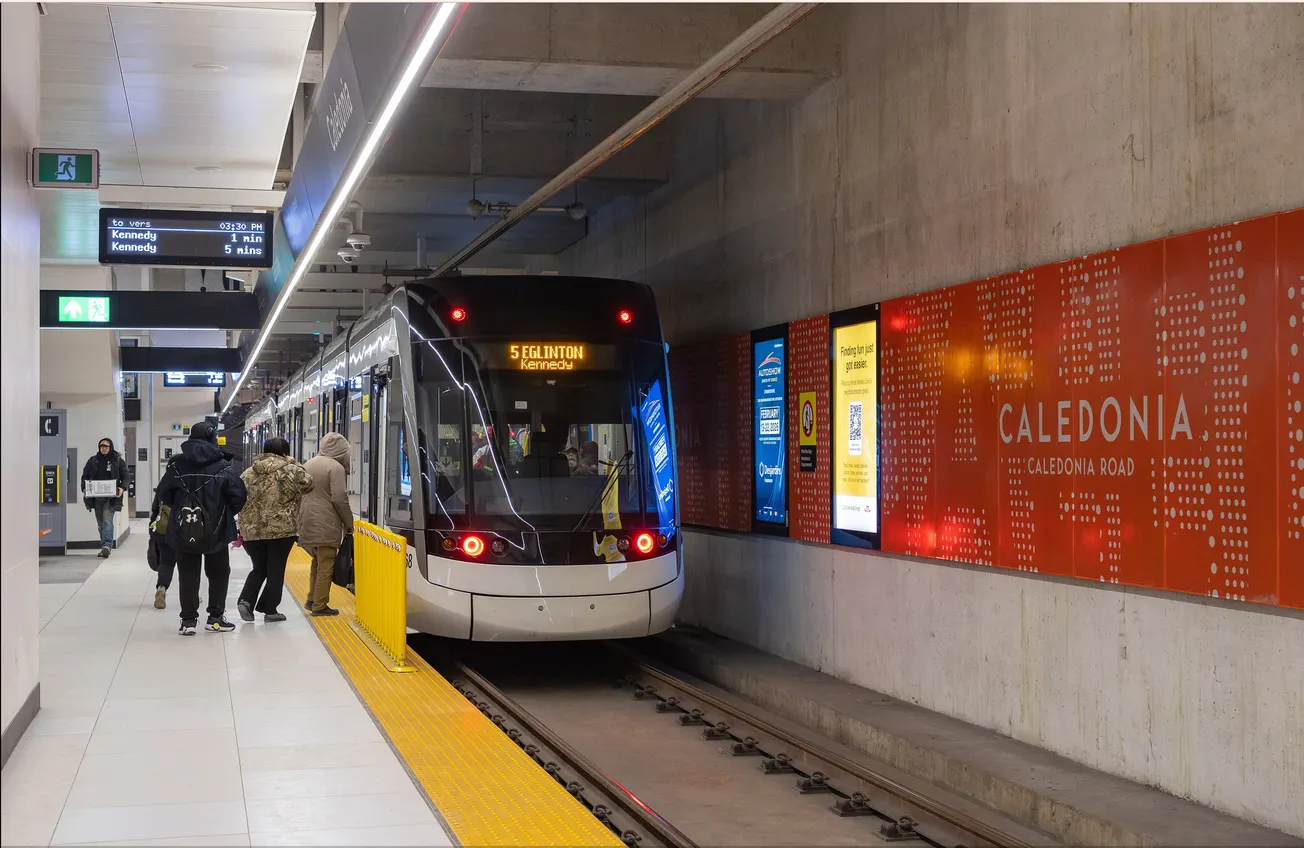
A couple of points I should get out of the way immediately. In my book Straphanger, published in 2012, when Rob "Crazytown" Ford was still mayor, I titled the penultimate chapter "The Toronto Tragedy." The idea was that Toronto had a decades-long transit building deficit. Everyone I talked to made the obvious point that Toronto's subway system was grievously deficient for a city of its size; the "Downtown Relief Line," which was first planned—what, in the 1920s?—wasn't being seriously discussed. Since then, the Greater Toronto Area has embarked on a serious rail transit expansion. This year saw the launch of two light-rail lines, about which more later. That yawning gap in the subway system is finally being filled (albeit slowly: tunnelling for the Ontario Line, which will add 15 stations to the subway network, began in April, with completion estimated for 2031).
But Toronto transit is not just its subways, streetcars, and buses. (The TTC's bus network, by the way, is very impressive, and, as some transport scholars, like the late Paul Mees, have argued, could serve as a global model for serving sprawled-out suburbia.) The GO Transit network, which operates commuter service in the Greater Toronto and Hamilton area (more broadly, the "Golden Horseshoe," which extends from Lake Erie to Georgian Bay, and is home to 9.8 million people) carries 61 million people a year on its trains alone. Contrast this with Canada's two other large cities: Montreal's EXO commuter trains carry just 7 million riders a year, and Vancouver's West Coast Express (which a lot of people in Vancouver are unfamiliar with) carries just 1.7 million a year, on a single, 8-station line.
I spent some time gazing in wonder at GO trains converging on Union Station. The lozenge-shaped, green-and-white double deckers are impressively long and capacious. This is one heavy-hauling system; it even carries more riders a year than Chicago's Metra (a paltry 37 million a year). The system, though, is badly in need of an overhaul.