There are no ads on the HIGH SPEED newsletter, and there never will be. (No A.I. slop, either!) It's entirely supported by readers like you. I publish it on a platform called Ghost, because I don't like the way Substack channels reader money to Nazis, fascists, white supremacists, and the likes of Andrew Tate. Unlike Substack, though, Ghost charges an annual fee. I want to keep HIGH SPEED going, but to pay that fee and continue doing the research, travel, and writing necessary to keep this up week in, week out, I need your support. I hope you'll consider becoming a paid member; you can follow the link to the sign-up portal here. And to all those who have already helped out by becoming a Rail Pass Holder or Founding Member, thank you!
// Within living memory, it was possible for people in North America to take advantage of a wonderful travel institution: the night train.
I'm not talking about the sleeper cars on long-distance trains, which still exist on some Amtrak routes in the U.S., and on three in Canada. (The Ocean, between Halifax and Montreal; The Canadian, between Toronto and Vancouver; and the train from Winnipeg to Churchill, Manitoba.) Most of these are geared towards the leisure travel market, with prices to match.
But a generation or two ago, it was commonplace to book an overnight ticket on an inter-city train. The idea was that you'd save a night in a hotel room, sleep while you covered a few hundred kilometers, and wake up not only refreshed, but also transported. As far back as the 1860s, the Pullman company specialized in catering to this market, coupling their luxurious, custom-made coaches to regularly-scheduled trains. By the early 20th century, Pullman coaches were carrying 100,000 passengers a night, making the rolling sleepers the largest hotel chain in the world. (I write about my visit to Pullman, Illinois, an early Robber Baron suburban utopia, in this post.) The coming of highways and short-haul jet service put an end to this most civilized form of travel. I caught the tail-end of the era in the 1990s, when I took an overnight train, the Cavalier, from Toronto to Montreal; I remember having a shower and shave after a restful night in a lower berth, and rolling into Central Station sipping coffee and reading the day's Globe and Mail in the Park Car at the rear of the train, refreshed and ready to start the work day.
Night trains have lasted a lot longer in Europe. In the 1990s and 2000s, I took it for granted that a sleeper was usually an option for getting to your destination; at various times, I remember reserving a couchette to get to Paris, Lisbon, and Vienna. By the beginning of this decade, though, many of the sleeper routes had vanished, killed off, it was said, by the rise of such dirt-cheap budget airlines as Ryanair and Easyjet, with their promise of €29 getaway weekend to glamorous European capitals.
Then, in the wake of the Covid pandemic, a funny thing happened: the night train, until then quivering on the brink of extinction, started to make a comeback.
The timing was good. To honour their carbon-emission reduction commitments, France and Spain were pledging to kill off short-haul jet service within their borders. Trains, which emit a fraction of the carbon per passenger-kilometer of planes and cars, were well-positioned to reclaim their role in inter-city transport, this time around, sheathed in a patina of virtue.
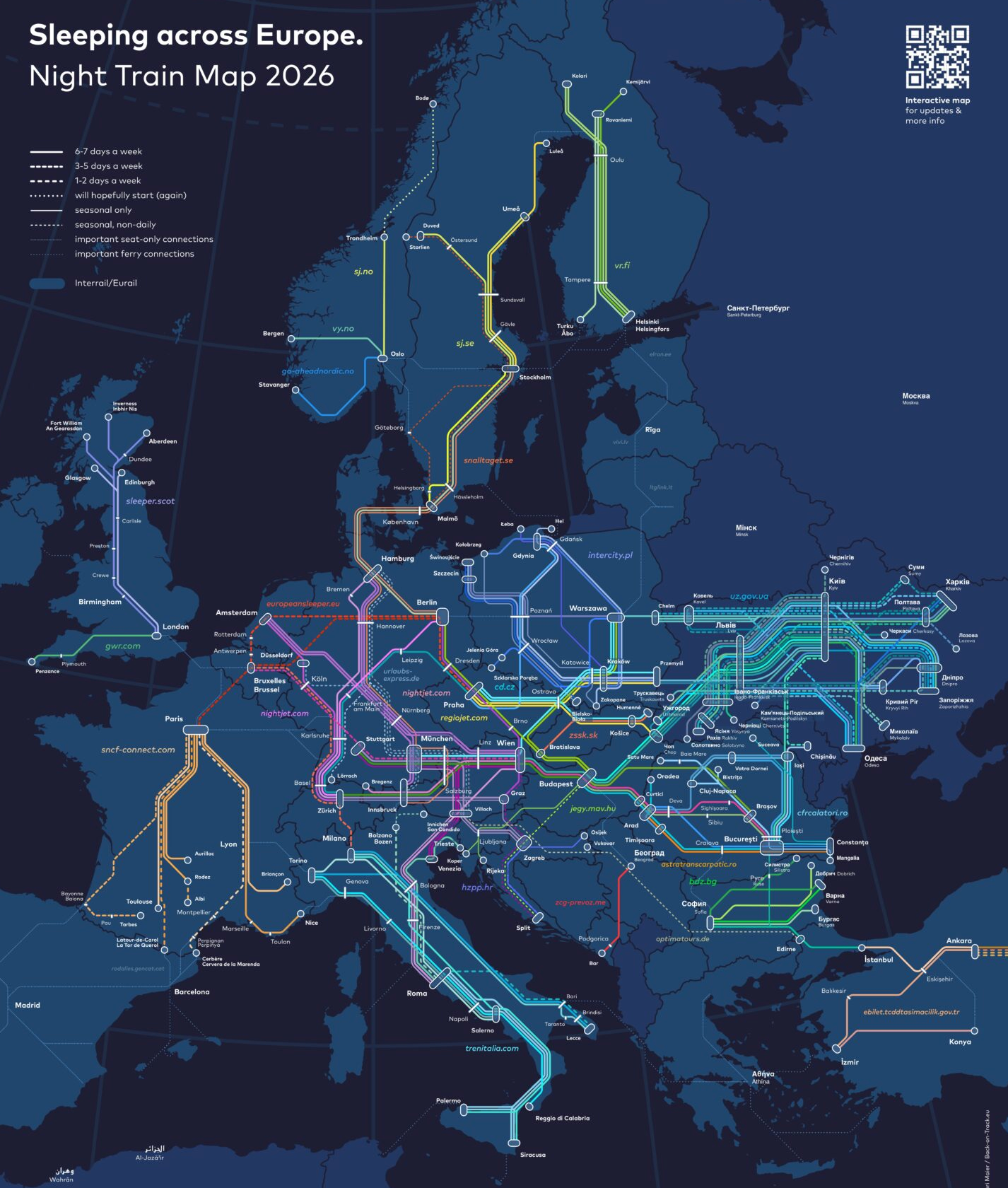
(Check out the above screenshot of the impressive, and genuinely attractive, map of sleeper routes from the Back on Track website, maintained by a group that advocates for the restoration of night train service in Europe.)
I've been watching the rise of the 21st-century iterations of Pullman and the Compagnie Internationale des Wagons-Lits (they of the Orient Express) with interest, and no little envy, and promising myself I would get around to booking a berth on a Nightjet or European Sleeper the next time I was on the Continent.
It was only last month, though, that the occasion presented itself: a family vacation, with my wife and two sons, who are ten and fourteen years old.