There are no ads on the HIGH SPEED newsletter, and there never will be. (No A.I. slop, either!) It's entirely supported by readers like you. I publish it on a platform called Ghost, because I don't like the way Substack channels reader money to Nazis, fascists, white supremacists, and the likes of Andrew Tate. Unlike Substack, though, Ghost charges an annual fee. I want to keep HIGH SPEED going, but to pay that fee and continue doing the research, travel, and writing necessary to keep this up week in, week out, I need your support. I hope you'll consider becoming not just a free subscriber, but a paid member; you can follow the link to the sign-up portal here. And to all those who have already helped out by becoming a Rail Pass Holder or Founding Member, thank you!
// Over a dozen years ago, my book Straphanger, in which I visited 14 cities around the world to look at their public transport systems, was published. I think it still offers a solid overview of the topic. (I was happy to see this glowing video review, by George Liu, which just appeared on YouTube.) But if I were going to write a sequel, I'd definitely include a chapter on a form of transit that's taken off—ahem— in the last decade: the urban cable car.
To research such a chapter, I'd almost certainly make a beeline for La Paz, Bolivia. I spent some time in this magical Andean city when I was researching my book The Devil's Picnic, but that was well before they started work on what has now become the world's largest cable car network. There are now ten interconnected lines, and they've started work on an 11th, which will take passengers to El Alto, a historically disfavored community perched high above the city center. (I spent a couple of hours in traffic getting to El Alto to have my fortune read, with coca leaves and llama fetuses, in a shack on the Calle de las Brujas.) Mi Teleférico, as the system is called, already carries 300,000 passengers a day, and will number 36 stations when it's complete.
I gave a nod to the urban cable car—aka un téléphérique, aka an aerial tramway—in the New York chapter of Straphanger, when I took a ride on the Roosevelt Island Tramway. Since 1976, it's been lofting passengers from the Upper East Side of Manhattan to Roosevelt Island. Like the Portland (Oregon) Aerial Tram, it's meant to provide a solution to a geographical challenge. In New York, the barrier is the East River; in Portland, it's a hill, atop which a university campus is located.
Many people will have taken a ride on cable car in a leisure setting, to get to downhill ski slopes. The Swiss and the Austrians, who have a lot of experience with accessing mountaintops, are masters of the technology. A cable network is an ideal solution for a mountainous city like La Paz: its topography is incredibly convoluted (its airport sits at 4,000 metres, with the rest of the city dipping down to 3,200 metres). But there are also a half dozen cities in France with cable car transit lines, and most of them aren't particularly hilly.
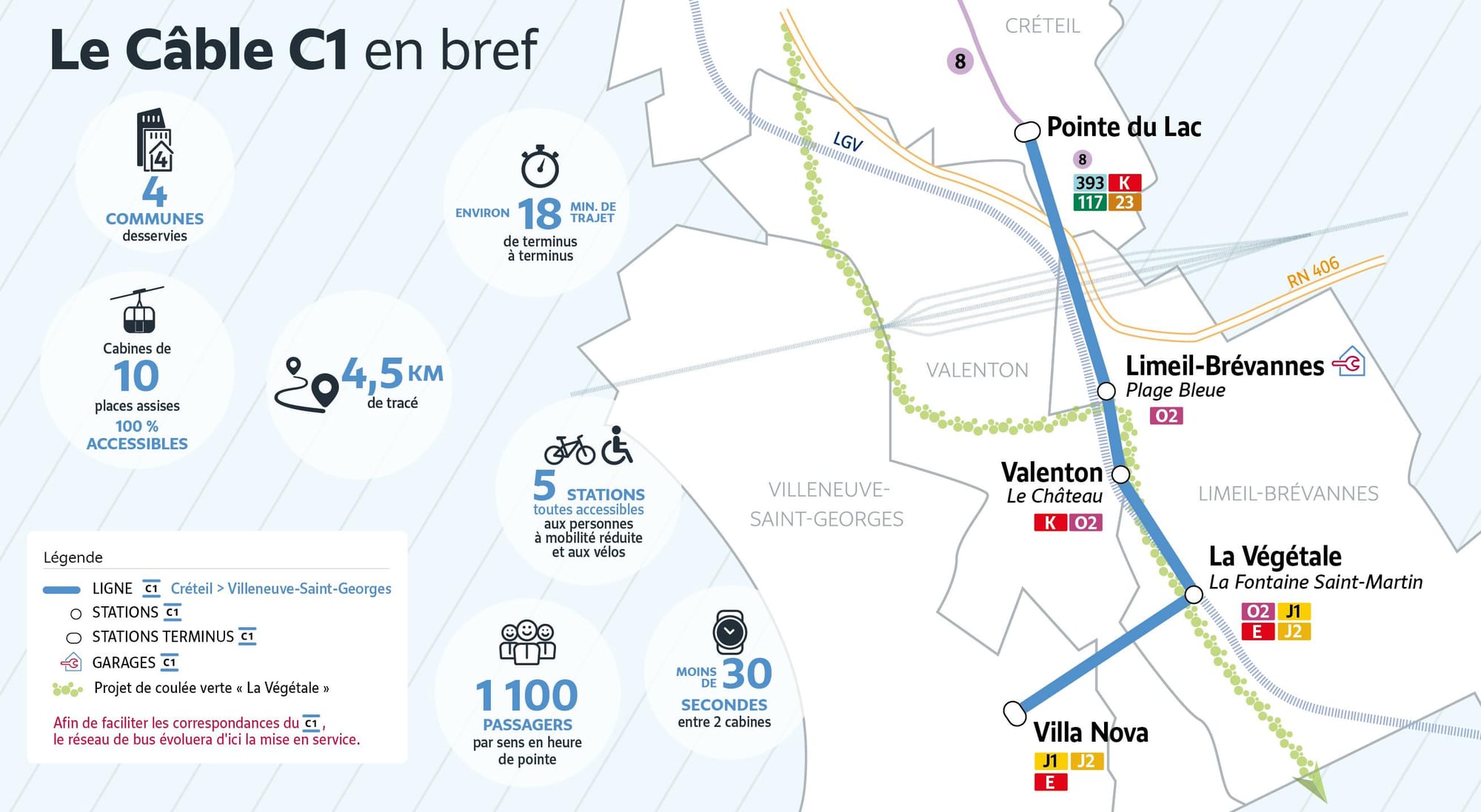
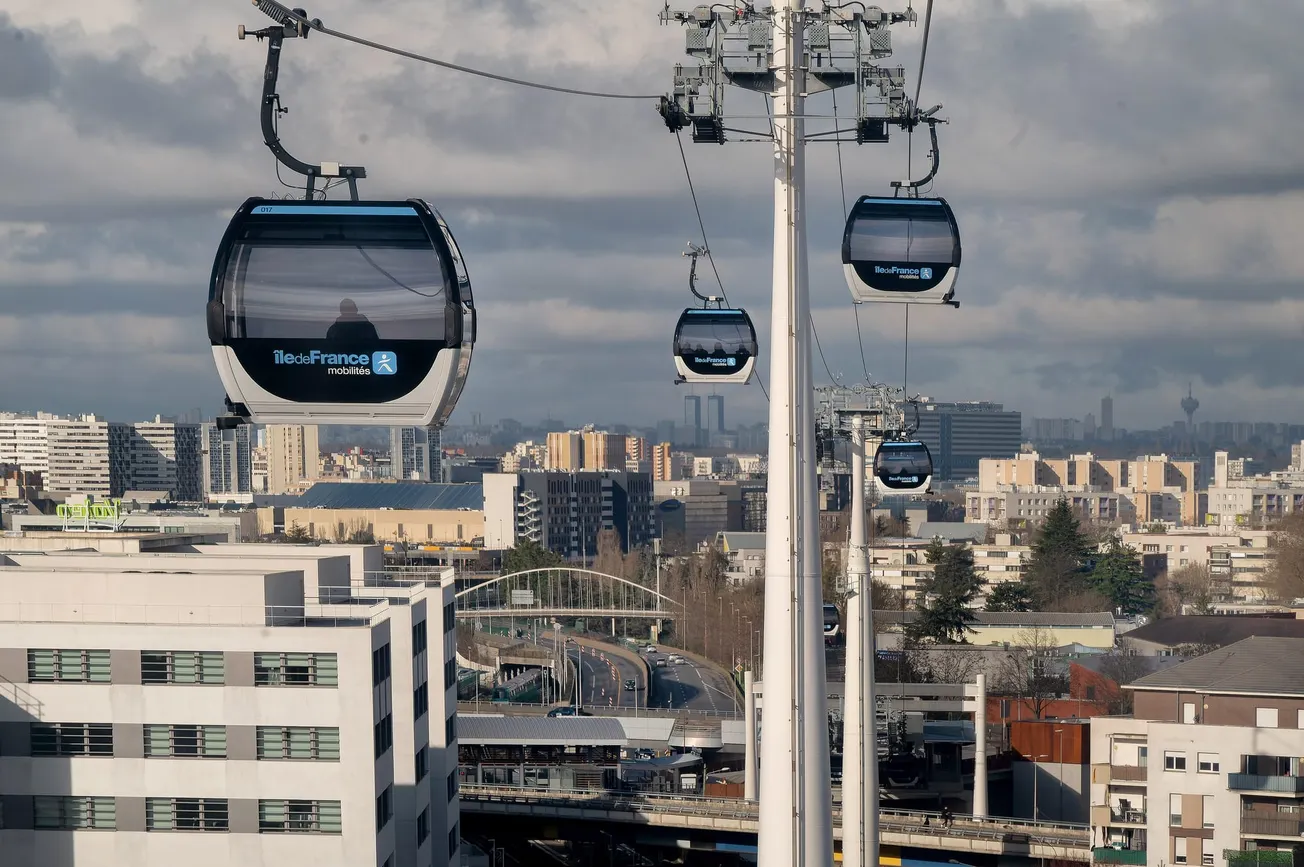
When I was in Paris last month, I rode métro line number 8 to its southeastern terminus, to check out the latest born—and longest—of France's cable cars. Câble 1, or C1 for short, links the Pointe du Lac métro station to a southern suburb in the Val-de-Marne called Villa-Nova.