There are no ads on the HIGH SPEED newsletter, and there never will be. (No A.I. slop, either!) It's entirely supported by readers like you. I publish it on a platform called Ghost, because I don't like the way Substack channels reader money to Nazis, fascists, white supremacists, and the likes of Andrew Tate. Unlike Substack, though, Ghost charges an annual fee. I want to keep HIGH SPEED going, but to pay that fee and continue doing the research, travel, and writing necessary to keep this up week in, week out, I need your support. I hope you'll consider becoming not just a free subscriber, but a paid member. Your subscription will help me keep this train rolling; you can follow the link to the sign-up portal here. And to all those who have already helped out by becoming a Rail Pass Holder or Founding Member, thank you!
// Last month I went to Morocco to research a feature on the country's evolving high-speed rail network. (More on that soon!) It was my first time in the North African nation. While I'd done some homework on the ONCF, the national rail operator, and the extent of its services, I hadn't gotten up to speed on the state of public transit in Morocco.
I was impressed with what I found. Tramways, commuter rail, bus rapid transit—in a lot of Moroccan metropolitan areas, the transit options are way beyond what you'd find in all but the largest cities in the United States and Canada.
I arrived in the coastal city of Casablanca, the largest in Morocco, and its economic powerhouse, after a seven-hour flight from Montreal. I'd taken up my hotel's offer to pre-book a taxi. Big mistake. The driver, I was told, would be waiting for me outside Terminal 2 holding a sign reading "Taras Grescoe." No such luck. I spent 10 minutes wandering among the taxi drivers gathered outside, before texting the hotel, who told me the driver was on his way. He found me half an hour later—an eternity in jet-lag land—but not before I had to send him WhatsApp photos of my exact location.
As I was leaving the terminal, I noticed signs directing me towards lower-level train platforms. D'oh! If I'd done my research, I would have known in advance that Casablanca has had a train-t0-the-plane since the 1990s. A one-way ticket to Casa Voyageurs, the main rail station, costs 60 dirhams ($9 Canadian, $6.50 US); my cab ride was five times as expensive. Though the traffic wasn't bad—the highway to the airport, once notoriously clogged, has recently been expanded, which has improved matters, at least for a year or two—I would have much rather been looking out the window of a train. What's more, Casa Oasis, one of the several stations in the Casablanca area, was just a five-minute walk from my hotel. Lesson learned.
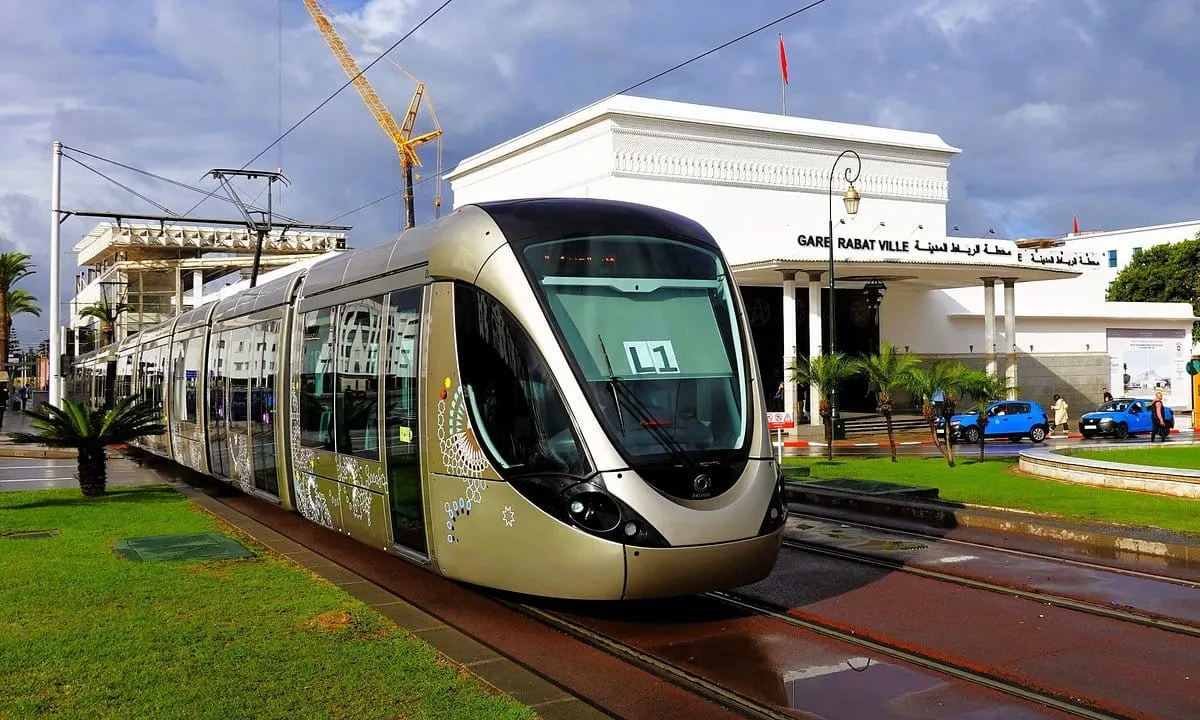
After a four-hour crash/siesta in my hotel, I roused myself for my first meeting, at Casa Voyageurs, the main station. The desk clerk told me I'd find a tram stop a ten-minute walk away. Sure enough, in the middle of the rushing traffic on a broad boulevard, I spotted two on-street platforms, and a modern-looking tram pulling away.
Why you're better off in a tram in Casablanca...
A word about traffic in Morocco. It's bad. Really bad. Imagine a sandstorm of taxis (grands and petits, more on those later), scooters, trucks, and private cars: beat-up Dacias, Renaults, Dusters...