Skip to content

Bogotá Gets Its Metro

As Colombia Votes, Chinese-Made Trains Are Being Tested in South America's Next Mega-City
by Darío Hidalgo*

(HIGH SPEED once again welcomes a guest author, Darío Hidalgo, who was one of the architects of TransMilenio, the largest bus rapid transit [BRT] system in the world when it opened 25 years ago in Bogotá, Colombia. This time Darío, who I met while researching my book Straphanger, is taking a look at the city's long-awaited metro system, which is due to start running in 2028. Colombia is voting for a new president this month; a Trump-supporting candidate has won the first round, but the popularity of the metro on both sides of the political spectrum means there's little doubt the project will go ahead.)

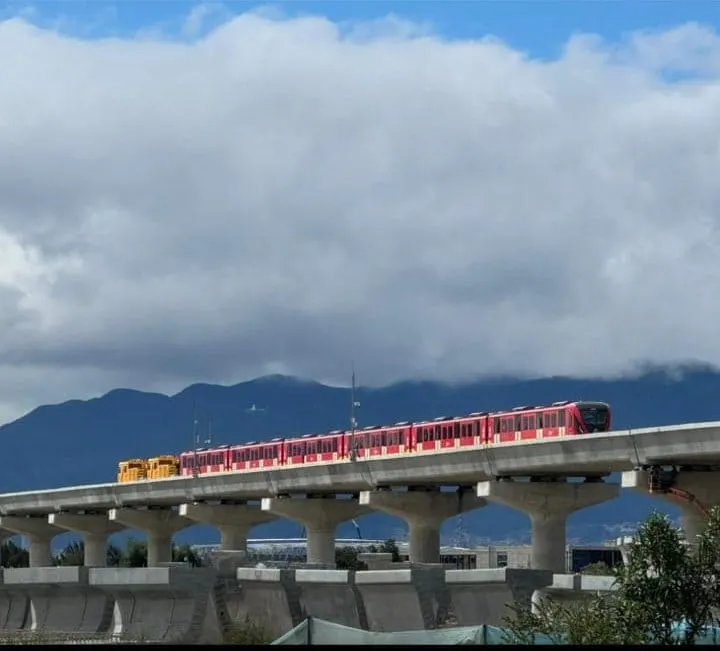
// Last month, the people of Bogotá, the capital of Colombia and its largest city, were able to see a shiny red Chinese-made metro train running on a section of a 23-kilometer-long viaduct. It was just a small trial, part of the long technical requirements for this fully automated metro system, which is expected to launch in March, 2028. But the excitement was impressive.

I got an unusual number of views on an X post showing the train in action. (Yes, I remain on that toxic network, in part out of respect for my small community of followers). Checking the reactions, I saw that, at least in this particular bubble, most people are genuinely happy about the prospects of riding a metro in Bogotá.

A metro has been a long time coming. Bogotanos first started planning a metro in the 1940s, and, over the years, multiple projects were proposed, without any of them becoming reality.

The Bogotá metropolitan area is on the brink becoming a megacity: in the next five years, more than 10 million people will call this Andean plateau home. The city has a very large public transport modal share (35%), but along with that has come ever-increasing motorization: more people are opting for private motor vehicles, particularly motorcycles.

The route of the first line of Bogotá's metro.

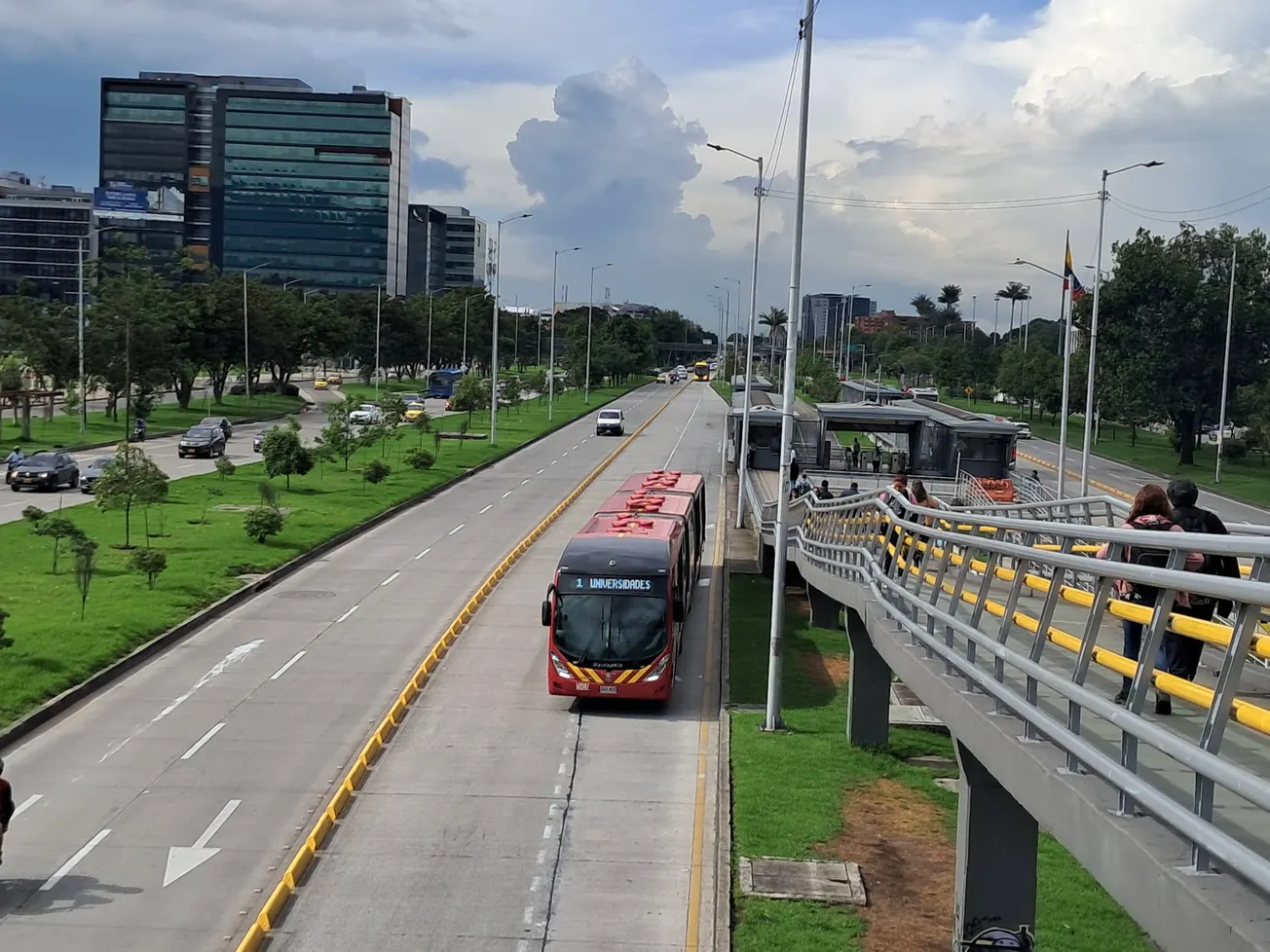
Bogotá is globally renowned for being the home of one of the world’s earliest, and most extensive, high-capacity bus systems. TransMilenio is recognized as a “gold standard” example of bus rapid transit (BRT). 

I was part of the team that implemented TransMilenio in 2000, and over the first years I was convinced we found a way to advance mass transit at a relatively low cost and with large positive impacts. Many cities in the global south looked at Bogotá as a model for advancing public transportation, and I started going to many places in Asia, Africa and Latin America to help governments apply the concepts that worked well in Bogotá during the system’s early years.

💡
Bogotá’s biggest challenge is curbing private vehicles use, especially motorcycles. Investing in high quality transit is part of what is needed.

But after a few years in operation, TransMilenio was not perceived as the only way to go in our city.  As I wrote in this dispatch, the system suffered from neglect and lack of expansion, particularly during its second decade. The TransMilenio system now has a low service quality rating: 35% of the users say it is satisfactory, claiming crowding as its main drawback. 

The fact is, though, from the start, the 114-km TransMilenio network was envisioned as part of a multimodal system, with metro rail serving the main corridors. 

Why is a major city in a middle-income country just completing a rail transit line in 2028, when most cities in the world have featured rail transit since the last century? In other words, why has it taken so long for Bogotá to build a metro?

More after the break...

There are no ads on the HIGH SPEED newsletter, and there never will be. (No A.I. slop, either!) It's entirely supported by readers like you. I publish it on a platform called Ghost, because I don't like the way Substack channels reader money to Nazis, fascists, white supremacists, and the likes of Andrew Tate. Unlike Substack, though, Ghost charges an annual fee. I want to keep HIGH SPEED going, but to pay that fee and continue doing the research, travel, and writing necessary, and to publish guest authors like Darío, I need your support. I hope you'll consider becoming a paid member. Your subscription will help me keep this train rolling; you can follow the link to the sign-up portal here. And to all those who have already helped out by becoming a Rail Pass Holder or Founding Member, thank you!

The story is long, but may be explained by a mix of lack of funding, political misalignment between the national and the local levels, and protracted planning processes that go beyond election cycles.

To begin with, a high-capacity metro system is costly. The main driver of cost is the size of stations and trains. In the case of Bogotá, the cost is above $180 million per kilometer. That’s nowhere near as expensive as the one billion per kilometer it cost to build the Second Avenue subway in New York City; nor, however, is it as cheap as the $80 million per kilometer of the new lines in Santiago, Chile. But it is very significant outlay for transport budgets, at both the national and the local levels. Globally, most metro projects run well over budget, and fail to fulfill estimates of ridership; making Bogotá’s metro a success is going to require commitment and preparation. 

 The first metro in Colombia, in Medellín, tripled its cost during its thirteen years of construction, sowing fears that the same would happen in Bogotá. Thanks to excellent management, Medellín’s metro, inaugurated in 1995, is very well used and accepted. (It is also famous for its cleanliness. I once heard its General Manager, Tomas Elejalde, say: “it is not the most extensive metro, but it the best swept and mopped in the world.”)

 Building such a system in Bogotá will require alignment between the national and local level. Recently, this has been difficult to achieve, as municipal leaders are usually at odds with the political affiliation of national leaders. For instance, in 1996, then president Ernesto Samper wanted to initiate a metro line and funded the feasibility studies, but the then-mayor Antanas Mockus considered that the cost was excessive and wanted to advance other options first. 

 When Enrique Peñalosa was elected mayor in 1997, he rapidly reached an agreement with Samper, but the final investment decision was passed to his successor Andrés Pastrana (1998-2002). Pastrana was not emphatic in advancing the project and in 2000, his team indicated there was no opportunity to fund it, as the country was recovering from a collapse in the banking system, and an earthquake that affected coffee growing regions.

In 2000, Peñalosa, then in his final year as mayor, agreed to partially shift the budget committed to the metro for the expansion of TransMilenio, which he started with municipal funds.

TransMilenio quickly became a victim of its own success; many lines are overcrowded, and rider satisfaction is low.

Peñalosa, who always indicated a metro was not his priority, failed in two subsequent bids for election. His opponent, Samuel Moreno, mayor from 2008 to 2011, started the planning process from scratch, setting forth a new route for the metro.

 Moreno’s proposal was accepted by the national government in 2010, but with a lot of conditions, including feasibility studies with advanced pre-designs. Naturally this took some years to complete. Moreno’s successor as mayor of Bogotá, Gustavo Petro (who is currently Colombia’s president), presented preliminary designs for a 29-kilometer underground line in 2014, with a price tag double the preliminary estimates.

The proposal was accepted by the national government in 2015, and space was assigned in the long-term budget to fund the project. Then Enrique Pen̈alosa was re-elected as Bogotá’s mayor. He changed the project from underground to elevated, with an intention to save money and reduce construction risks. He signed the contract with a Chinese consortium, at the end of 2019, just before the end of his four-year term.

The project has continued under mayor Claudia López (2020-2023) and current mayor Carlos Fernando Galán (2024-2027). The project is now over three-quarters complete. Remarkably, it is also on budget, and on schedule. 

There are good reasons for Bogotanos to be happy about their metro. It will have 16 stations, and, at 72,000 passengers per hour per direction, it will be one of the highest capacity metros in the world. Trains, which will have a commercial speed of 43 km/hour, and a maximum speed of 80 km/h, will be driverless; such fully automated systems—among them Vancouver’s SkyTrain, Honolulu’s Skyline, Paris’s Grand Paris Express, and Montreal’s Réseau Express Métropolitain—are a growing trend in mass transit. The capital cost of Bogotá's metro is $3 billion. 

Design, construction and operation of the first line were awarded to China Harbor Engineering Company and Xi'an Metro, and the first train was built in Changchun by China Railway Rolling Stock Corporation CRRC. They have already delivered 11 of the initial 30 trains to Bogotá. The depot is designed to receive 30 additional trains, which may be ordered gradually over the years.  

The construction has involved advanced techniques. The piles supporting the viaduct are pushed precast elements PHC, which are sunk up to 60 metres below the surface. The precast U-shaped beam sections are made in the same site where metro trains will be parked and maintained. They are moved in place, and then elevated by gigantic launching beams. Each 25- to 40-metre span takes about a week to complete. 

Metro construction, which employs more than 17,500 people, is one of the reasons economic activity in Bogotá is growing more than the whole country.  The metro will be fully integrated with the rest of the public transit system from day one. This is seldom the case in other metro projects. This will increase ridership and will provide multiple connectivity options. 

The city sees the metro as a great redevelopment opportunity in key corridors and around stations. The city agency has land acquisition rights and is expected to seize the opportunities provided by the great accessibility that comes with its operation. It is not just a mobility project, it is envisioned as a transit oriented development opportunity. 

 Bogotá will soon be part of the list of over 200 cities with a metro, including 23 in Latin America. Expected demand exceeds 650 thousand passengers per day, about 200 million passengers per year and 8.5 million passengers per km. (In contrast, Montreal carries 312  million passengers per year in its 69 kilometer metro network.)

The expectation is that Bogotá will continue expanding mass transit in the upcoming years. An open bidding process has started for line 2 (16 km, expected operation in 2035. There are studies for line 3 (25 km, expected operation 2040). Two commuter rail (train-tram) projects are being built, one going west (41 km under construction) one going north (49 km approved). There are also two ropeway gondola systems under construction, and 60 new kilometers of BRT.

This is the largest investment in multimodal public transport in the history of the city. I just hope this momentum does not stop. Colombia is in the midst of presidential elections. By the end of June, we will have a new president elect. The results of the national elections won't have an impact on the completion of the line under construction, though the new president will likely be called upon to decide whether to commission a third line.

Bogotá’s biggest challenge is curbing private vehicles use, especially motorcycles. Investing in high quality transit is part of what is needed. Probably we will also enhance car restrictions and introduce congestion charges. Most Bogotanos don’t own cars, yet we regularly place in the top ten most congested cities in international rankings. We need to provide better options. The good news is that we’ll soon have a metro to help out our extensive BRT system. 

* Darío Hidalgo is a transport and logistics professor at the Department of Industrial Engineering of Pontificia Universidad Javeriana, Bogotá. He was deputy general manager of Transmilenio S.A., the city agency in charge of the BRT system in Bogotá from 2000 to 2003. He was later a sustainable mobility and road safety consultant for international organizations in Latin America, Asia, and Africa, including work from 2007 to 2018 with the World Resources Institute. He is author of 158 academic publications and writes op-ed columns in El Tiempo and La Silla Vacía

THE LATEST PASSENGER RAIL NEWS

Zone 3: The Americas

In addition to making driving unaffordable, thanks to the spike in gas prices following the invasion of Iran, the Trump Regime is attacking passenger rail and public transit. House Republicans have cut transit funding by 22%, Amtrak by 69%, and capital investment grants for surface transport by 78%. Walking is still free, I guess... (Here's the link.)


Comments

Latest