This year, I've pledged to ride every passenger train in Canada, from the White Pass & Yukon out of Carcross to The Ocean, calling at Halifax, for a book to be published by House of Anansi, tentatively subtitled "Twelve Trains that Explain Canada." I'm about 60 percent of the way there, with the Tshiuetin to Schefferville, the train to Churchill, the Algoma Central, and a few others still left to ride. The trouble is, my advance covered about two months of living expenses, and this is an awfully big country. If you're a free subscriber, please consider upgrading: as a Railpass Holder ($7 a month, or $70 a year), you'll get every dispatch in full, the run of the archives, and a seat in the comments; as a Founding Member ($10 a month, or $100 a year), you'll also see your name—along with my eternal gratitude—in the book's acknowledgements. If just 100 of you upgrade, I can reach the end of steel. (Curious? Click here for the whole story.) All aboard—en voiture!
// When you opt to take a trip by train, rather than going by plane or car, you're doing the right thing—right?
Well, that's the right answer, most of the time, in most places. But not—for reasons that will soon become clear—on the continent I happen to call home.
Broadly speaking, the environmental case for passenger rail is rock solid. It all comes down to the elementary friction-reducing physics of steel wheels running over steel rails: put a horse on a road, and it can pull a cart loaded with 450 kilograms; put the same horse on a simple railway, and it can haul 10,000 kilograms. A modern train can haul a tonne of cargo 1,790 kilometers—all the way from Montreal to Thunder Bay—on just ten litres of diesel, and an average-length freight train carries as much cargo as 280 trucks. (Passenger trains, which tend to be lighter than freights, require even less fuel.) According to the International Energy Agency, as a global average, trains require 4.1 tons of oil equivalent for every million passenger-kilometers, compared to 42.98 tons per million passenger-kilometers for planes. In general, by opting to go by train rather than by plane, you're responsible for consuming 10 times less energy than doing the same trip by plane.
Now, I did say, in general. The devil, as always, is in the details, or, more precisely, in the kind of train you're riding, and where you're riding it. This year, I'm working on a book about riding trains in Canada, and, as I cross this amazing nation, it's become pretty obvious to me that—depending on where I board the train—there are huge variations in the relative efficiency of rail transport.
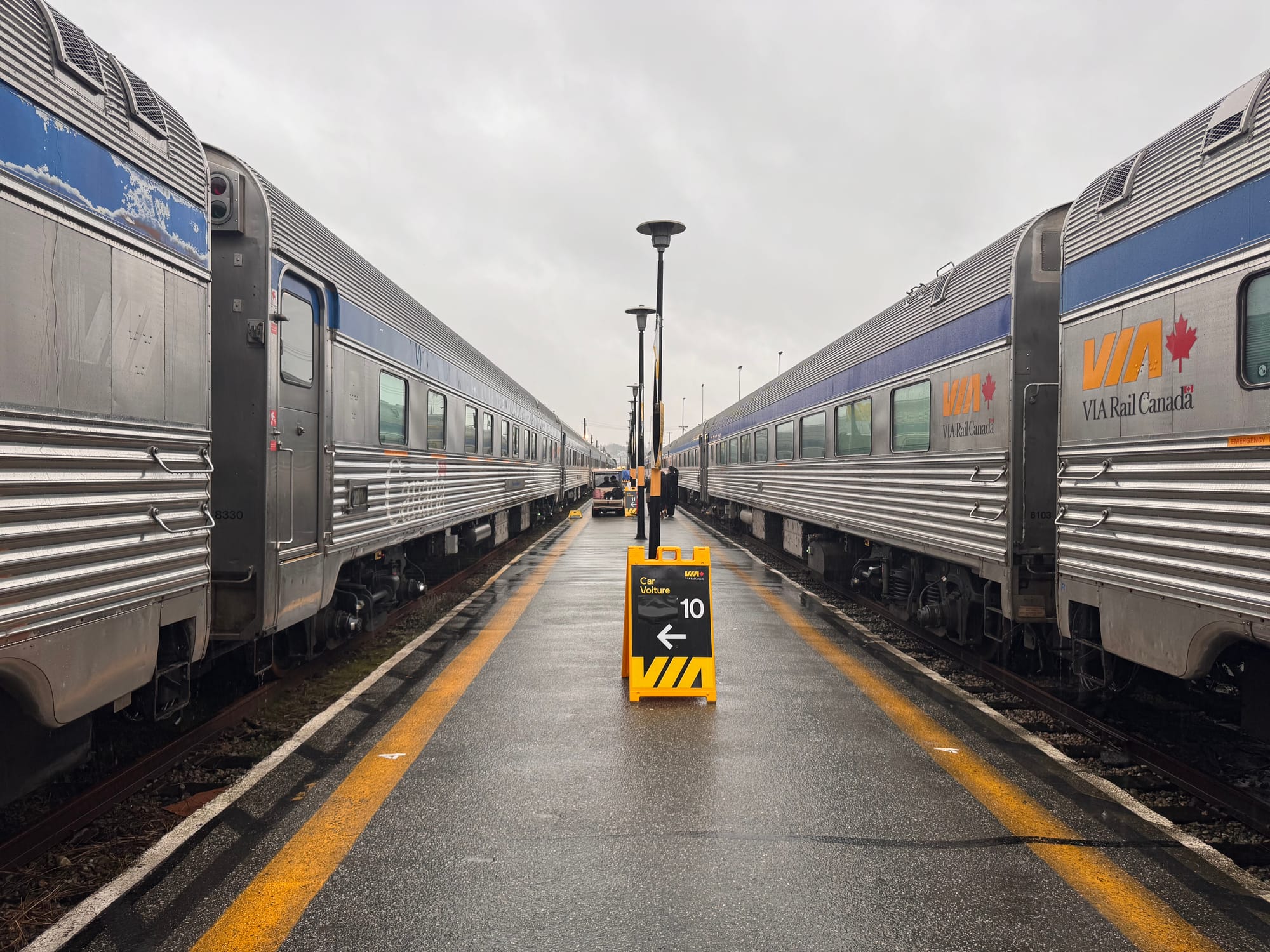
Most of my rail riding (apart from urban transport, on Montreal's REM, EXO trains, and the métro) is in the Corridor, as the route between Quebec City, Montreal, Toronto, and Windsor is known. Via Rail, Canada's national operator, carried 4.4 million passengers in 2025. (A laughably small number, by the way. Compare this to Morocco, which has roughly the same population as Canada, where national operator ONCF transported 55.6 million passengers in 2025. That, by coincidence, is the number of passengers Canadian railways used to transport—in the 1940s, when the country's population was just 12 million.)
Of that number, 4.2 million—95% of Via's ridership—rode Corridor trains. The remaining 200,000 or so rides occurred in the rest of Via Rail's, including its remote and essential services (for example, Trains 5 and 6 between Jasper to Prince Rupert) and its long-distance routes (the most famous being The Canadian, from Toronto to Vancouver).

The good news is that Corridor trains easily beat out cars and planes in terms of carbon emissions. Last week I rode a morning train from Montreal to Toronto with my youngest son; our Economy coach was close to being full, with all but a half dozen seats occupied. According to Via Rail's website, if we'd opted for a short-haul flight, each of us would have been responsible for emitting 186 kilograms of carbon; if we'd gone by car, 104 kilograms. The train trip put our emissions at 55 kilograms each. And the figure for plane travel doesn't truly reflect a flight's real impact on the atmosphere: the phenomenon of radiative forcing means that the other greenhouse gases in those contrails doubles or triples the warming impact of any given flight.

If you don't want to rely on Via Rail's figures, the University of Ottawa's Ryan Katz-Rosene did his own analysis, and came up with similar figures in this paper for Canadian Geographer (see chart above). Katz-Rosene's calculations bear out the international average, showing up to a tenfold reduction in carbon emissions per passenger when travelling by train.
The environmental benefits of train travel in Canada fall away outside the Corridor, though. The circuitous route that The Ocean, North America's oldest named train, takes between Halifax and Montreal means that the trip is far longer, in kilometers travelled, than the equivalent trip by plane. Katz-Rosene calculates that, per passenger, emissions are 1.4 to 2.7 times higher than doing the same trip flying. (Note that Gordon English, president of Ottawa-based Transys Research, questions Katz-Rosene's figures on The Ocean.) One of his recommendations to Via Rail is that it consider taking a shortcut across Maine. Clearly, now that many Canadians are avoiding crossing the border at all, this is a non-starter: the whole reason Intercolonial Railway was built where it was—as I explain in this post—was to avoid getting too close to the US, which, in the late-nineteenth century, as today, was a source of well-founded anxiety about invasion and annexation.
Katz-Rosene is on firmer ground when he compares flying from Toronto to Vancouver with taking the same trip on The Canadian. The former journey covers 3,350 kilometers, and proceeds pretty much as the crow flies. The latter journey, thanks to some complicated history and geography, covers 4,466 kilometers, and takes 97 hours; no crow would fly so crookedly. (That said, this year I took the train from Vancouver to Toronto, and we arrived earlier than scheduled—if only by one hour.) Not surprisingly, spending four days on a complicated journey crossing Canadian muskeg, prairies and Rockies on a train isn't as energy efficient as doing the same journey in just 5 hours in a plane. Even so, Katz-Rosene calculates per passenger emissions on The Canadian as being as little as 1.6 times higher than flying.
All of this would change, though, if Canadian passenger trains were powered by electricity, rather than by diesel. That switch isn't likely to happen for long-distance trains, such as The Ocean and The Canadian, nor for remote and essential services (the trains to Prince Rupert and Jonquière, for example).
Not that electrification, even in remote contexts, is out of the question: India has completely electrified its 69,000 rail network in the last decade, including its freight operations. And all 9,289 kilometers of the Trans-Siberian, the world's longest rail line, which crosses some pretty challenging tundra and taiga, are powered by overhead wires.
Canada still relies on diesel-electric locomotives for all of its inter-city rail transport. Compared to European trains, North American locomotives are massive. Particularly in the west and the north, they need all the hauling power they can muster to cross mountain chains and muscle through snowbanks. The newest of them, including the trainsets put into service by Siemens in the Corridor in the last five years, are lightweight and fuel efficient. But the smartest thing to do would be to electrify every route-kilometer, from Quebec City to Windsor (and, for good measure, to Sarnia and Niagara Falls). This is the low-hanging fruit in Canadian decarbonization: convert all passenger rail in the major population centers—including Montreal's EXO commuter rail, and Ontario's GO trains—to electricity.
The proposed Alto high-speed line, intended to link Quebec City, Ottawa, Montreal, and Toronto, is electric. That's just standard operating procedure when it comes to bullet trains around the world (even Amtrak's Acela draws power from catenary wires; Florida's Brightline runs diesel-electric Siemens trains, but, as I've argued, it's not high-speed at all). The thinking, I imagine, is that Canada isn't embarking on the sensible work of electrifying the line that carries 95 percent of the nation's passengers because, if all goes well, electric Alto trains will be doing all the heavy lifting.
In a decade. Maybe. If we're very, very lucky.
That's a big gamble, as anyone who has been following the, ahem, progress, of high-speed rail in Britain and California will know. Who knows if Alto will get built? But that uncertainty shouldn't stand in the way of leaving fossil fuels behind. Electrification of passenger rail should be default policy of governments at the municipal, provincial, and federal levels.
A detail in Katz-Rosene's paper caught my attention. He writes that Canada's entire rail infrastructure is responsible for 6.6 megatonnes of carbon emissions a year. That may sound like a lot, but it's just 3.3 percent of the emissions produced by Canada's transport sector. And, after oil and gas, the transport sector is Canada's second largest emitter (between 22 and 28% of carbon emissions, depending on who you ask). That's a remarkably low figure, considering that trains handle just under three-quarters of all the freight in this country. Any way you measure it, rail transport is on the side of the angels: it's cars, trucks, planes (and ships), which account for 96.7 percent of the transport sector's emissions.
(The same holds true for the rest of North America: all but a rounding's error worth of the inter-city passenger rail on this continent is hauled by diesel locomotives, the kind that began vanishing from Asia and Europe decades ago.)
Is Canada headed in the right direction? Well, I like the fact that we're moving beyond mere studies of high-speed rail, and that we're finally putting structures in place to get those continuously-welded tracks laid.
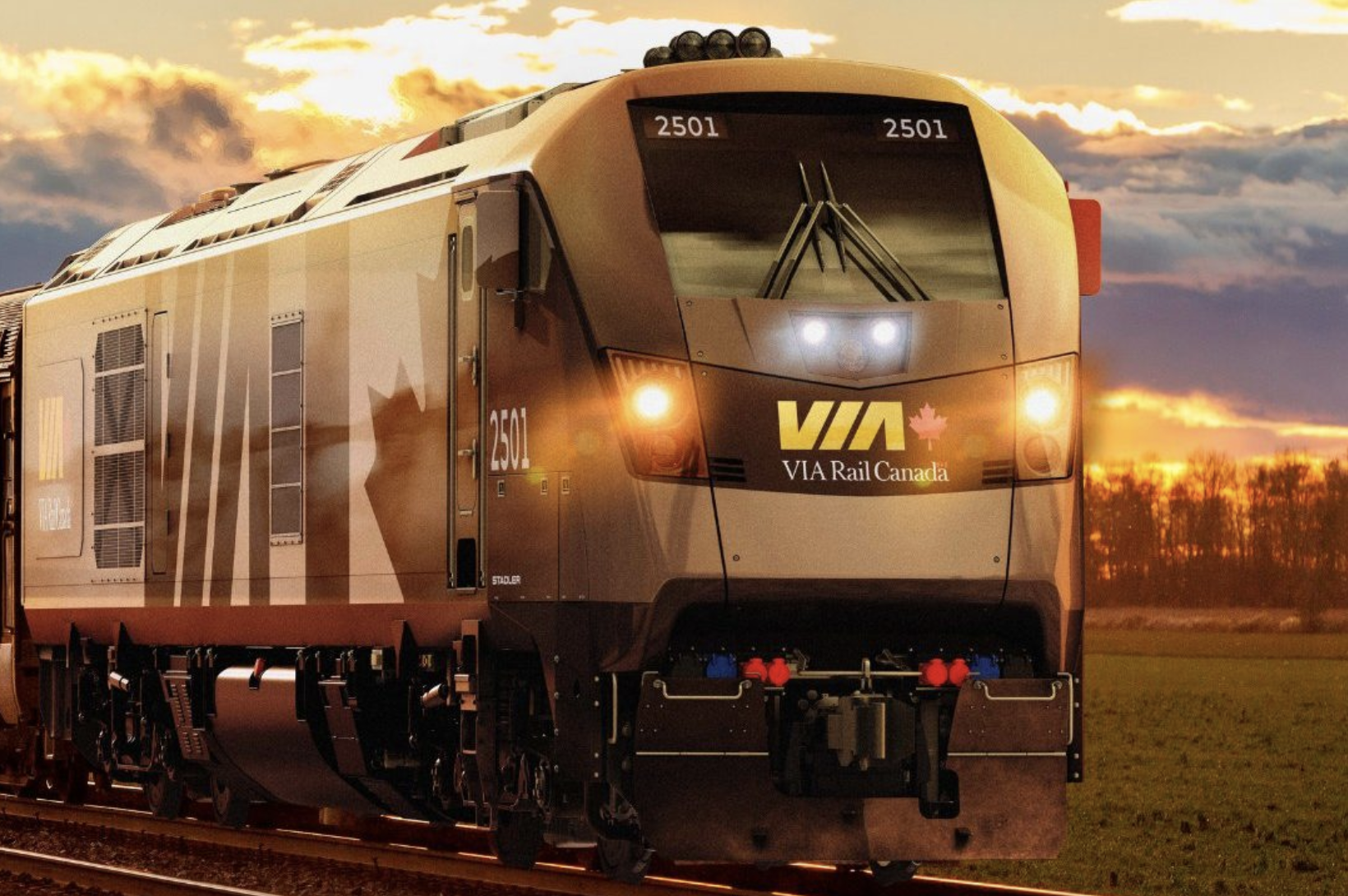
And, in a mid-distant time horizon, there's good news about changes coming to Via Rail's long-distance fleet. Part of the reason trains like The Canadian and The Ocean are so carbon-intensive is that they consist of aging locomotives, pulling, in some cases 70-year old railcars. (The Budd streamlined cars, which date back to 1954, are solid, but also very heavy.) Via has signed a contract for 313 new passenger cars, to be made by Alstom, for its long-distance fleet, and for 45 new diesel-battery locomotives, to be made by the Swiss company Stadler. The new trainsets are designed to function at temperatures as low as -50 C, and will be far more energy-efficient than what's rolling on the rails right now.
It's not electrification—but it will still be a big step forward in making rail travel in Canada a truly "green choice."
THE LATEST PASSENGER RAIL NEWS

Zone 3: The Americas
I've just returned from a trip to Alberta. Passenger rail, apart from the Rocky Mountaineer and The Canadian, has been absent from that province since 1990. Alberta's current premier, Danielle Smith, is something of a railfan: she actually ran a restaurant in a retired railcar in High River with her husband (see above). When Prime Minister Carney announced that he'd be recommending Smith's plans for a high-speed rail line between Edmonton and Calgary (a natural city pair for high-speed rail, with a combined population of 3 million, and separated by 300 kms) to the Major Projects office, I welcomed the news. Then, a couple of days later, the real news broke: Carney's Liberals had approved a pipeline to the B.C. coast, which will bring a million more barrels a day of tarsands oil to the world market. That pipeline will traverse lands I just crossed by rail, where the forests have been burnt black by the wildfires caused by—burning too much oil. Backing the pipeline makes political sense against the backdrop of Alberta's coming referendum on separation. The separatists are going to have a lot more trouble claiming Carney (who grew up in Edmonton) is just another eastern bastard who never gives them what they want. But it's the wrong move for the future of the planet, and is making me second-guess the good news about investment in passenger rail.
What's the right term in situation like this? Greenwashing isn't quite right. Maybe...railwashing? (Here's the link to the high-speed rail announcement; and here, the link to the Pacific Link pipeline announcement.)