Skip to content

We Got Our School-Street!

The Street Outside our Children's Montreal School is Closed to Cars—and Open to People
There are no ads on the HIGH SPEED newsletter, and there never will be. (No A.I. slop, either!) It's entirely supported by readers like you. I publish it on a platform called Ghost, because I don't like the way Substack channels reader money to Nazis, fascists, white supremacists, and the likes of Andrew Tate. Unlike Substack, though, Ghost charges an annual fee. I want to keep HIGH SPEED going, but to pay that fee and continue doing the research, travel, and writing necessary to keep this up week in, week out, I need your support. I hope you'll consider becoming not just a free subscriber, but a paid member. Your subscription will help me keep this train rolling; you can follow the link to the sign-up portal here. And to all those who have already helped out by becoming a Rail Pass Holder or Founding Member, thank you!

// Regular readers of HIGH SPEED will know that, as much as I'm an advocate for fast electric trains (mainly as a way to cut down on polluting travel by plane and car between cities) I'm also a supporter of slowing things down on city streets.

Much of this comes from being the father of two school-aged boys. We live in the Montreal borough of Outremont, close enough to their schools that they can walk, or ride bikes. But for over a decade now, making sure they can do that safely has been a source of stress for me and my wife. For the last four years, I've been part of a committee at L'École Alternative Nouvelle-Querbes—the school my eldest son attended, and where my youngest son is now in fourth grade—to limit vehicular traffic outside the school.

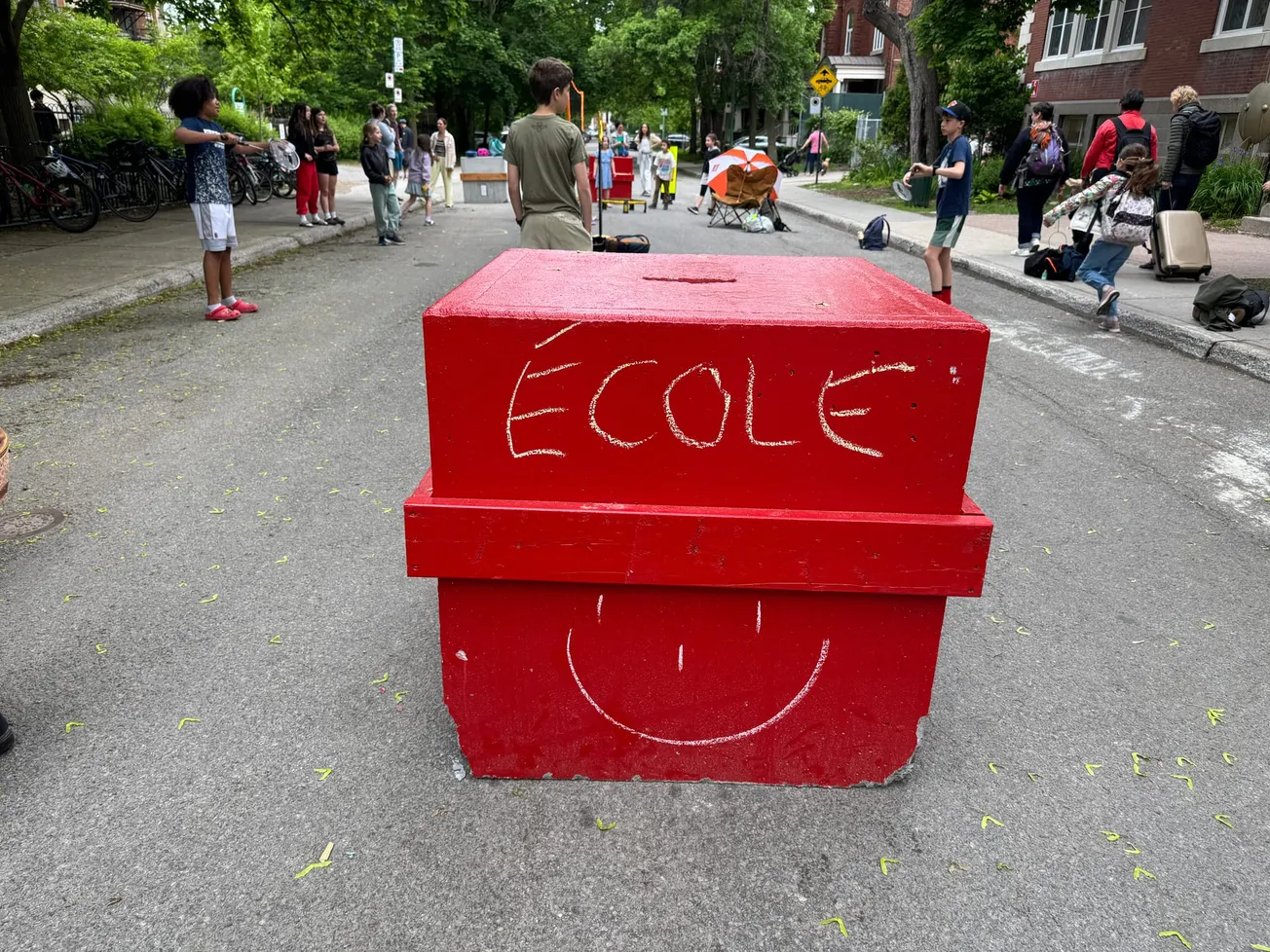
To make the trip to and from school as safe as possible, we asked the borough to close Avenue de l’Épée, a one-way street outside L’École Alternative Nouvelle Querbes, to cars, trucks, and other through traffic. This June, we finally saw our efforts pay off.

In the final weeks of the school year, municipal work crews dragged three large concrete blocks into place at the south end of the street. Another trio of blocks was placed farther up the street, creating a 50-metre-long stretch where no vehicular traffic was permitted.

💡
That morning, I watched a driver swerve around the slower car ahead of him, jump the curb, and drive up the street at full speed with two wheels on the sidewalk.

The street instantly became a miniature piazza. Kids chalked hopscotch ladders onto the pavement, badminton nets were erected, and a neighbourhood organization held bike-repair workshops. When the afternoon bell rang, students from the private school on the other side of Avenue de l’Épée, which has a much smaller outdoor courtyard, turned the newly liberated street space into an impromptu playground. Many of the families who live on the street belong to Outremont’s Orthodox Jewish community, and Hasidic kids were among the first to join in the fun; on the weekend, they played on scooters and bikes in front of their homes, as safely as if they lived on a suburban cul-de-sac. The street hadn’t so much been closed to cars, as opened to people.

Then, on the last day of school, the concrete blocks were removed. That morning, I watched a driver swerve around the slower car ahead of him, jump the curb, and drive up the street at full speed with two wheels on the sidewalk. (Fortunately, there were no kids walking on it at the time.) The street closure, which had been approved with the understanding it was a temporary pilot project, was officially over: the flood of traffic had returned, and, for the foreseeable future, the street once again belonged to drivers, rather than kids.

This post is for subscribers only

Subscribe

Already have an account? Sign In

Latest