It's a long-running catastrophe. Large parts of Canada have been forsaken by passenger trains, which for generations guaranteed reliable, and affordable, transportation for people of all ages and classes.
To make matters worse, inter-city bus service, which was put forth by federal governments, both Conservative and Liberal, as an acceptable alternative to the gutting of one of the world's great rail networks, has vanished in much of Canada, leaving dwellers in remote, rural, and indigenous communities isolated and abandoned.
Newfoundland had a much-loved railway, which linked St. John's and Port aux Basques by 1898. (Fun fact: the last spike was driven in St. John's by the future King George V.) After Newfoundland joined Canada in 1949, the line was taken over by Canadian National. The Caribou was known—unofficially, and definitely affectionately—as "The Newfie Bullet," making 20 station stops across the island at an average speed of 39 km/h. In a province deficient in roads, the train was a year-round lifeline to the interior and the outports, the latter mostly served, when the Atlantic permitted, by boats. The end of The Caribou, including its dining and sleeping cars, in 1968 marked the first discontinuance of an important passenger-rail service in Canada. Its unpopular replacement, a gruelling 15-hour bus ride, was arguably responsible for the loss of six of seven Newfoundland seats in that year's federal election.
Passenger trains have also completely disappeared from Cape Breton Island, Prince Edward Island, the Gaspé Peninsula, and Vancouver Island. The east coast of Vancouver Island was served by self-propelled Dayliner railcars, on the old Esquimalt & Nanaimo Railway, a line built by coal baron Robert Dunsmuir. (Though service there ended in 2011, the Island Corridor Foundation, jointly owned by 14 First Nations and five regional districts, is energetically campaigning to bring trains back to the 289-km Victoria–Courtenay route.)
One of the most flagrant erasures of rail service happened in Alberta, a province whose population has now topped 5 million. (The Calgary region in particular is growing fast, with an estimated population of 1.84 million in 2025, 150,000 of them arriving in the previous two years.) The only inter-city passenger service of note is Via Rail's The Canadian, which crosses the province on its way from Vancouver to Toronto and back, following the old northern transcontinental route of Canadian National's Super Continental, by way of Edmonton and Jasper.
This was not always the case. Within living memory, Alberta was served by two transcontinentals. That's something I can testify to, because I remember riding The Canadian; my family relocated from British Columbia to Alberta in 1978, crossing the Rockies by way of the southern route—the original Canadian Pacific transcontinental—to disembark (ahem, detrain) in downtown Calgary.
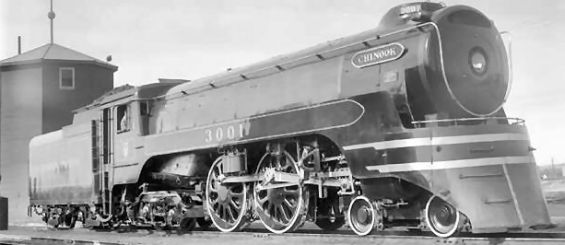
At the time, there was also a regularly scheduled Via Rail train connecting Calgary and Edmonton, the provincial capital. The link started as the Calgary and Edmonton Railway Company—in 1891—before becoming part of Canadian Pacific seven years later. Starting in 1936, this route was served by massive Chinook steam locomotives, which were famously fast: one topped out at 112.5 mph/181 km/h (which, come to think of it, is faster than any diesel-electric runs in this country in the Year 2026). By all reports, this was one classy train: four cars, including a mail and express car, a baggage-buffet coach, and two day coaches, featuring dark mahogany interiors and separate men's and women's lounges. The Chinook service was supplemented by two conventional trains, The Eskimo and The Stampeder, in tribute to the rival football teams of Edmonton and Calgary. Starting in 1954, self-propelled diesel Dayliner cars were introduced, reducing the 300-kilometer run to 3.5 hours. At the height of the service, four trains ran in each direction a day. The last Dayliner ran on Sep. 7, 1985, with federal transport minister Don Mazankowksi blaming the cancellation on too many drivers trying to "beat the train" at level crossings.
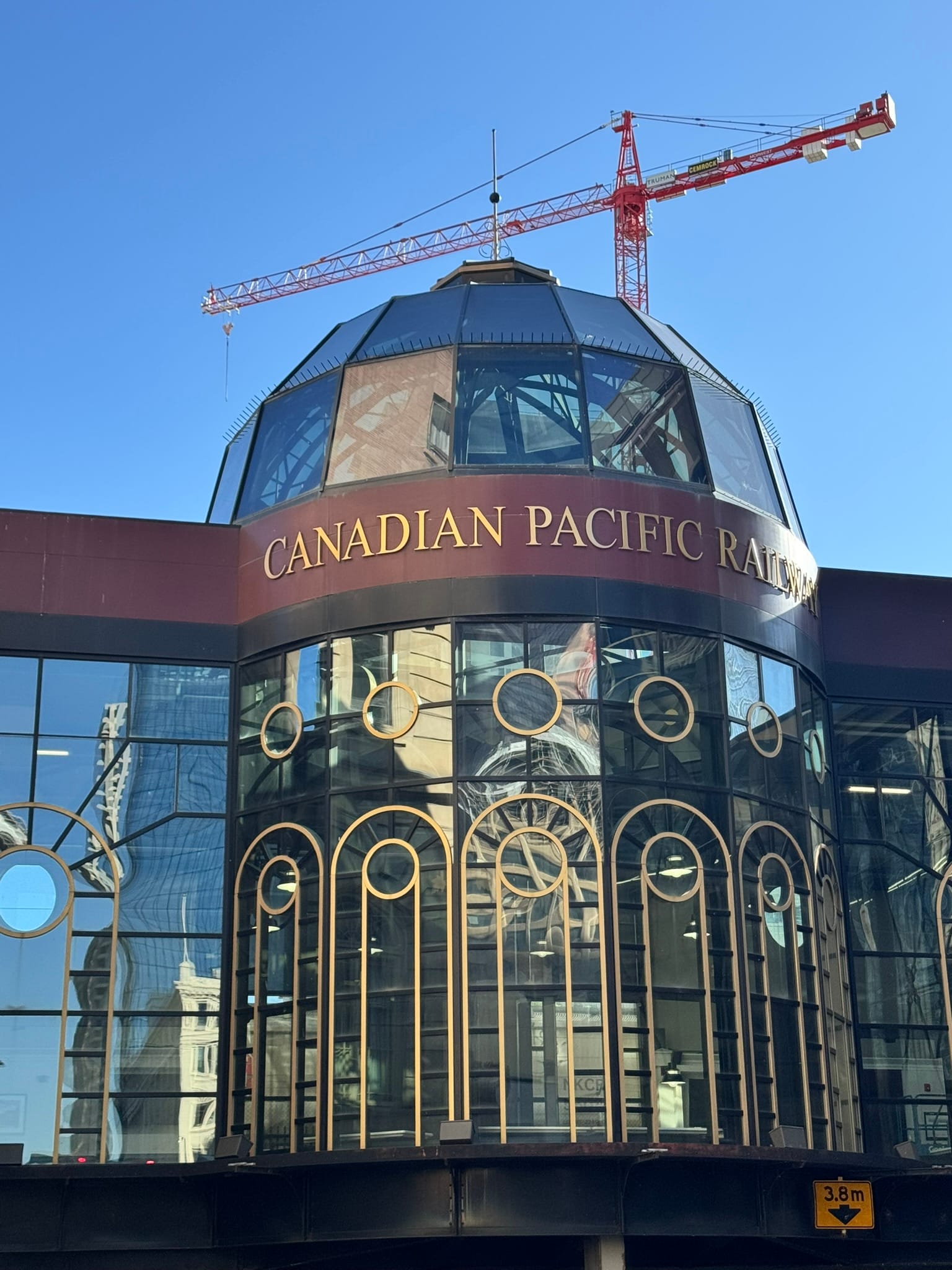
Last week, I actually did ride a train into Alberta—an excursion train, which began in Vancouver and terminated at Banff, its easternmost stop (I'll be writing much more about this experience in upcoming posts). From Banff, I had to continue on to Calgary by road, where I stayed at the Palliser Hotel, a railway palace hotel built in 1914 by the Canadian Pacific Railway (CPR). There are currently no intercity passenger trains serving Calgary, a place that has become a byword for unrestrained suburban sprawl, and where urban highways are officially known as "trails." Like many railway hotels, the Palliser was built next to a train station, allowing easy access for weary long-distance passengers. But the CPR station was razed in 1966 to make way for the Husky (now the Calgary) Tower, Cowtown's municipal phallus, which would be dwarfed just seven years later by Hogtown's CN Tower. (Sorry, not sorry, pardner!)
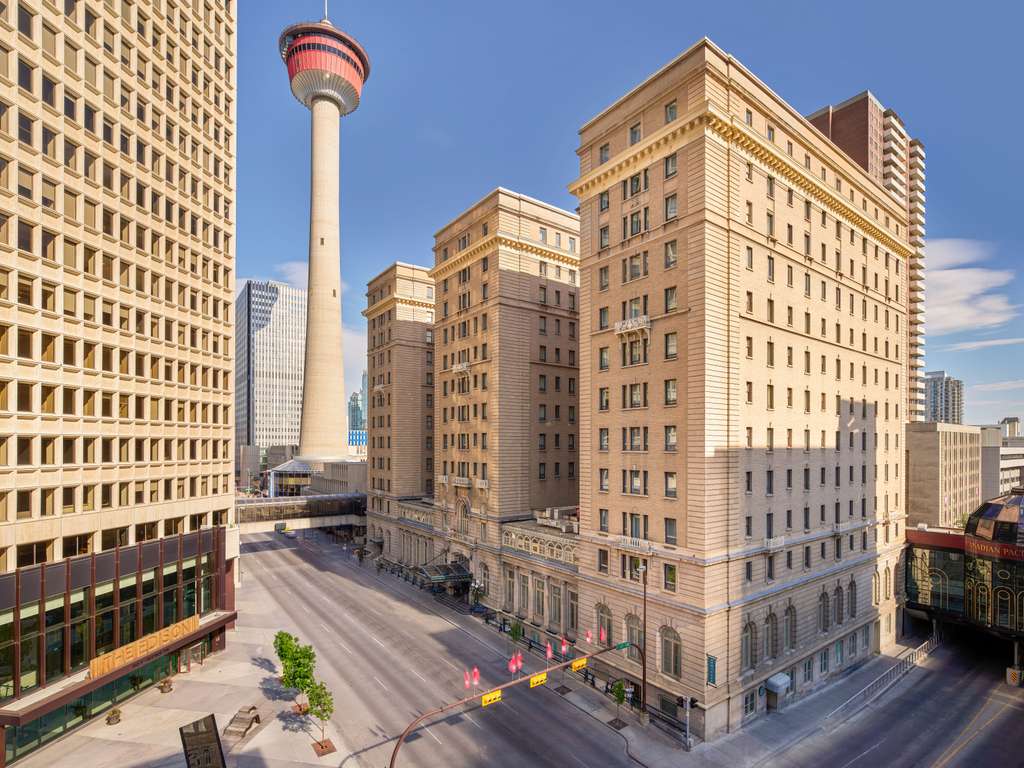
But rail is far from absent from this city, whose very location on the Bow River was determined by the CPR. In addition to the tracks of the C-Train, a light-rail network that next year will extend to the airport, the city is shot through at its very center by east-west CPR lines. (The downtown neighborhood is known as "The Beltline," which seems appropriate—the tracks seem to cinch and constrain the city in its historic midriff. I was briefly stuck in traffic caused by an over-height 18-wheeler that had come to a sudden stop, wedged beneath one of the underpasses meant to allow passage north and south beneath the tracks.)
For most of its history, the HQ of CPR was Montreal, but in 1996, it moved to Calgary, which put it closer to its major sources of freight revenue, grain and fossil fuels. Now known as Canadian Pacific Kansas City, it bowed out of the passenger rail business, which had long since ceased to be a cash cow.
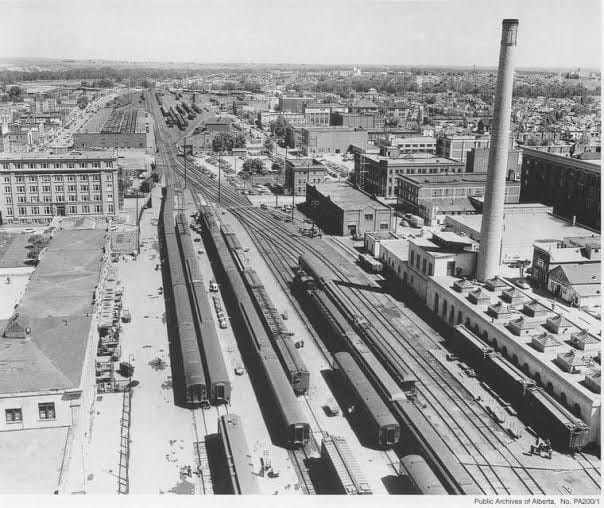
That's why I was surprised to glimpse what looked like a very substantial-looking locomotive, in a livery of bright green, in the covered passageway over the underpass next to the Palliser. I was given a tour of the hotel, and an employee led me through the kitchen to a corridor that led to the corporate HQ of CPKC. It turns out there's a fully-functional railway platform right there, exactly where you'd hope you might find one, a couple of hundred paces from the reception of Calgary's leading railway hotel.
A CPKC employee told me they were depot tracks, connected to the non-functional Via Rail station near the Calgary Tower side of the hotel, and they lead to CPKC's mainline. (Which means you could, in theory, ride a train from the Palliser Hotel in Calgary all the way to tidewater in Vancouver.) Interestingly, this is one of North America's first hydrogen-powered freight locomotives; along with CSX, CPKC is retro-fitting diesel locomotives, and now has a fleet of seven, which are already hauling freight long distance.
(From the company's website: "On September 4, CP 1200, along with its dedicated fuel tender CP 10001, joined a consist that included three diesel locomotives and 152 loaded gondolas. Together, they pulled a fully loaded bulk train from Sparwood, B.C. to Golden, B.C. The very next day, this cutting-edge hydrogen locomotive assisted in the return of 152 empty gondolas back to Sparwood." Readers of this newsletter will know that I'm a champion of electric-powered rail transportation. But I can see applications for hydrogen-powered trains, which are responsible for lower emissions and pollutants—at least on a local level—especially in remote settings, and Canada definitely is infinitely blessed with those. That said the hydrogen vs. diesel vs. electrification debate is a complicated one, and deserves its own dispatch.)
Before coming to Calgary, I paid a visit to the Banff station, which is now served only by the thrice-weekly Rocky Mountaineer excursion train. The last time I was there, the walls were covered with posters promoting a scheme to connect Banff to Calgary with a hydrogen-powered passenger train, hatched by Albertan entrepreneur Jan Waterous, owner of Liricon Capital Inc. This week, the Globe and Mail published an article on the scheme, which would use a CPKC right-of-way to link Banff National Park with Calgary's international network, by way of a "Grand Central Station" located on the same avenue where the Palliser Hotel sits.
The interesting thing about Alberta—which is seen, correctly, to be in thrall to motordom and fossil-fuel interests—is that there is also a surprising amount of enthusiasm for railways at the upper levels of government. The premier, Danielle Smith, is an advocate for better rail connections in the province. (This may have something to do with the fact that her husband David Moretta is a rail enthusiast, who has reported on the industry; some commentators see his involvement in high-level meetings as a conflict of interest.) "The Passenger Rail Master Plan," according to this source, released on June 5, 2026, "outlines a 30-year network that includes plans for a high-speed train of up to 320 km/h between Edmonton and Calgary via Red Deer, with up to one train per hour in the key corridor."
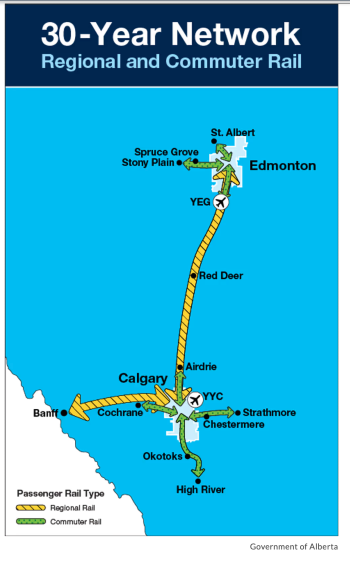
To this reporter, the program looks as amateurish as the graphics that accompany it; for the time being, I'm filing this under, "We have concepts of a plan."
Alberta does need more passenger rail. I believe that part of its sense of alienation from the rest of Canada—cue the October 2026 sovereignty referendum—may go back to a long-term resentment about Canadian Pacific screwing the west with its freight monopoly, followed by a sense of betrayal about its virtual abandonment by passenger rail companies.
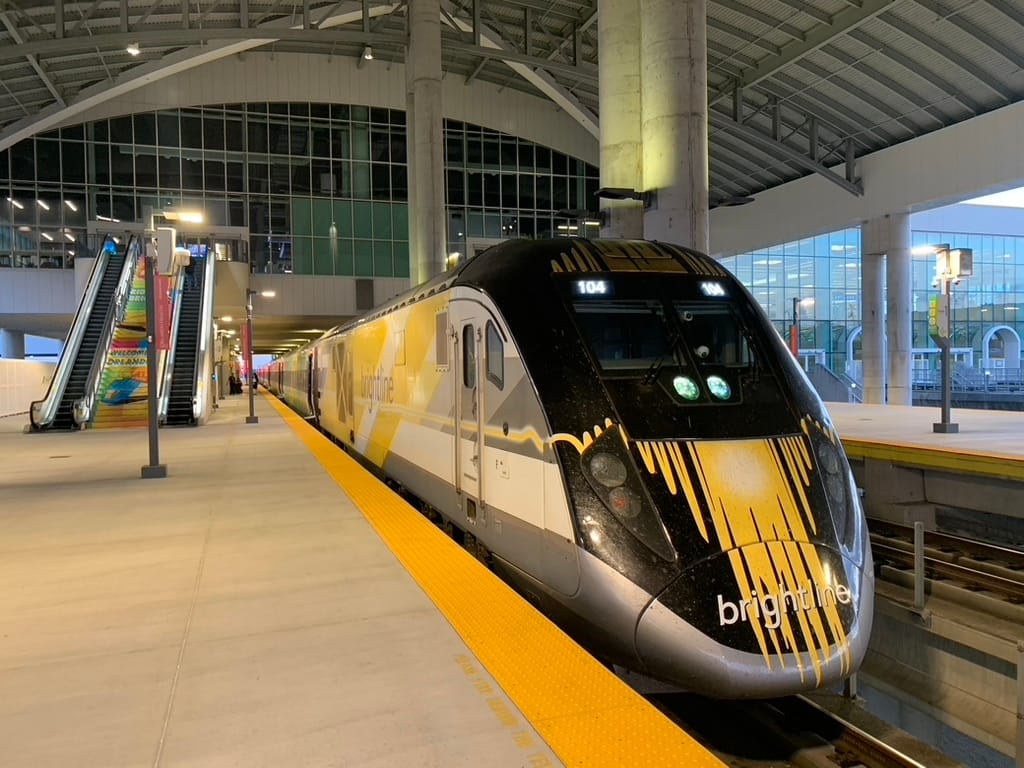
But the current schemes aren't about making transportation easier for Albertans. They're more in the realm of a Brightline, Florida's so-called high-speed rail, which I rode last year. That privately-run line is all about maximizing profits for shareholders. A private line to Banff would be about sweating an asset originally built with public money—the CPKC mainline—to make money off of tourists, and benefit entrepreneurs.
The antidote, I believe, is reconnecting Alberta with steel rails, for the benefit of its citizens. A good beginning would be a restoration of the Chinook route, under the auspices of Via Rail, between Edmonton and Calgary—and then we can work on reconnecting Calgary with the rest of confederation. That might go a long way to convincing Albertans they have more in common with their fellow Canadians than with the contingent of Americans rooting for them to break up the nation.
I know what I'd do next: See, there's this ghost siding in the Beltline, right next to the old Palliser Hotel...
THE LATEST PASSENGER RAIL NEWS
Zone 3: The Americas
Brightline, the private, for-profit "high-speed" line I write about riding in this dispatch, is facing $1 billion in debt, and may file for bankruptcy in Florida. No surprise there: it's deadly, expensive, not very fast at all, and more about real estate speculation than transporting people. (Here's the link.)