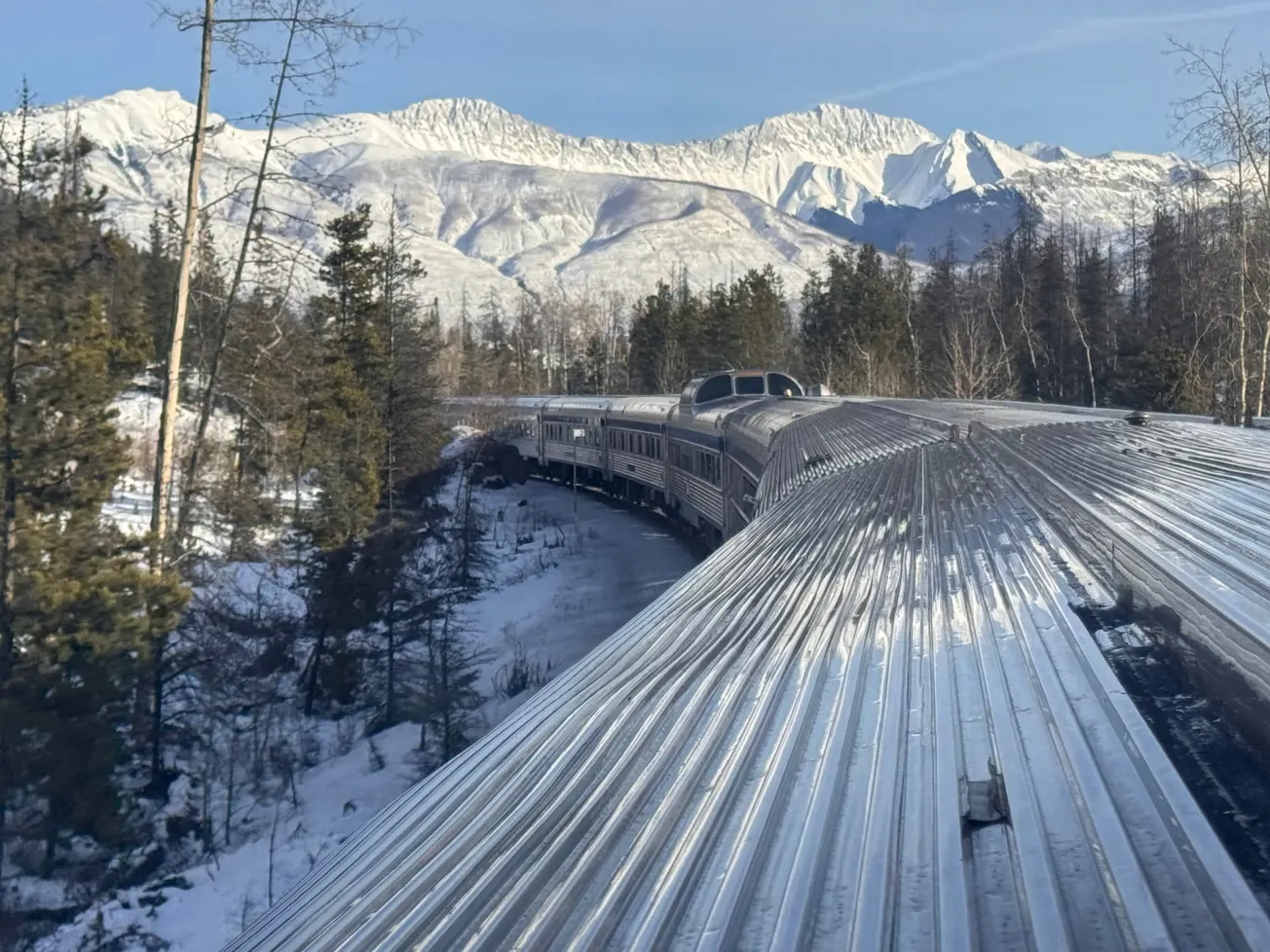
A big thank you to the 51 readers who’ve become Founding Members or Railpass Holders! Six weeks ago, I asked for your help to reach my goal to ride every passenger train in Canada for my book on the past, present, and future of passenger rail (to be published by House of Anansi). My advance only goes so far, so I’m counting on readers to fund my push to the end of steel.
My goal is 100 new paid members by the beginning of December: 49 to go! If you sign up, you’ll get the full version of every dispatch in your inbox each week, and free access to the archives. (And every Founding Member will be thanked for making the project possible in the book’s acknowledgements.) Sign up here.
I'll definitely be riding the North Wind to Labrador, but my next priority, as you'll understand from reading this week's dispatch, is getting aboard the Ontario Northland next month...
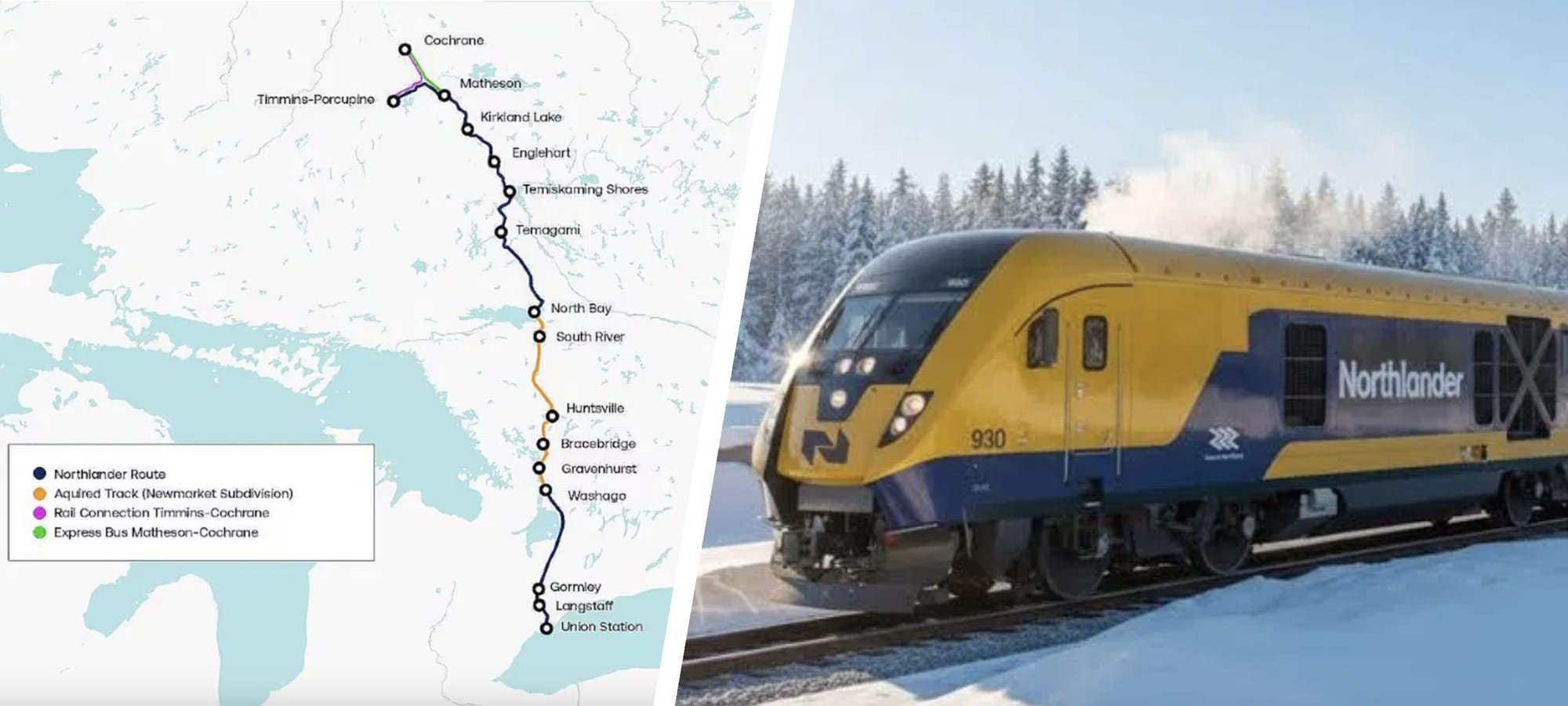
// On Dec. 10, 2026, a minor miracle is scheduled to occur in Toronto. For the first time in fourteen years, a passenger train headed for the eastern shores of Lake Nipissing and points north will roll out of Union Station. If all goes well, ten hours and forty minutes later, passengers in three Venture cars, pulled by a Siemens Charger locomotive in a fresh livery of brilliant blue and yellow, will arrive at a newly-built station at Timmins, over seven hundred rail kilometres north of downtown Toronto. The inaugural run of the Northlander will mark the return of Ontario Northland passenger rail service to a storied line that links the Great Lakes to the frigid waters of James Bay.
In North America, we’ve gotten used to hearing about railway lines disappearing, or, at best, being turned into trails for cyclists, hikers, and cross-country skiers. In this vast country, according to the standard narrative, we rely on runways and highways to travel long distances, while railways—outside the subways, commuter rail, and streetcars in big metro areas—are for nostalgics and tourists.
For the last year, the media has focused on the proposed thousand-kilometre Alto high-speed rail line, and the announcement that its first segment will link Montreal and Ottawa. The corridor between Quebec City and Toronto is home to nearly half the country’s population. But 6.6 million Canadians live in remote, rural, Indigenous, and northern communities, many of which have been petitioning for better public transportation. For them, the long-overdue revival of the Northlander and other passenger trains will dramatically change their lives for the better.
And, on a national level, there is also good news. In the latest federal budget, the Liberals announced a $1.2 billion investment, over three years, for operations and maintenance of Via Rail services. (Transport Canada has also announced $35 million to go to preserving essential services in rural and remote parts of Manitoba, Quebec, and Labrador for 2027-28.) That's in addition to this summer's $1.6 billion commitment to buy 45 new Stadler locomotives, followed by $4.7 billion to replace Via's long-distance, remote, and regional fleet.
Starting in 1836, when entrepreneurs in Lower Canada completed the Champlain & St. Lawrence Rail Road to link Montreal to the Richelieu River, Canada gradually built one of the world’s most extensive, and widely admired, railway networks. At its peak in the middle of the last century, a webwork of 49,000 kilometres of mainline tracks, and countless more of branch and shortlines, reached to remote hamlets, hunting camps, and resource towns, many of which owed their existence to the coming of the iron road.
The history of Canada's railways is inseparable from the exploitation of impoverished labourers, the steamrolling of Indigenous cultures, and a distinctly Canadian brand of genteel profiteering. But the heroic efforts of those who worked with pickaxes and nitroglycerin also left us with a fantastically ramified system of transportation corridors, any of which would cost billions if they had to be surveyed, cleared, and graded today. These nineteenth- and twentieth-century routes, brought back to life with modern low-emission rail technology, could go a long way to solving our transportation woes in the twenty-first century.
For decades, though, governments have abandoned existing lines. At their mid-century peak, Canadian trains carried upwards of 50 million riders. Since then, passenger rail service has disappeared entirely from Newfoundland, Vancouver Island, Prince Edward Island, and between Edmonton and Calgary. Under Brian Mulroney’s Conservatives, Via Rail saw half of its long-distance services axed. Gone are such much-loved trains as The Evangeline, The Cabot, Le Champlain, The Chaleur, The International, and The Ottawa Valley. In 2025, there were just 4.4 million rides on Via Rail, and 95.1 percent of them were in the Quebec City-to-Windsor corridor.
That’s why the imminent return of The Northlander is such welcome news. The line was chartered in 1884, in the hopes settlers wouldn’t follow the Canadian Pacific Railway to the prairies, but instead colonize “New Ontario,” as boosters then called the province’s north. The discovery of gold and silver near Timmins and Cobalt changed the emphasis from agriculture to resource extraction; for the well-to-do, a Pullman sleeping car service was offered from Buffalo to subarctic boreal forest. In 1964, the northern part of the line began to cater to tourists with the launch of the Polar Bear Express excursion train, which still runs between Cochrane and Moosonee.
Mike Harris’s provincial Progressive Conservatives were the first to target Ontario Northland for privatization or elimination. The provincial Liberals, under Kathleen Wynn, eventually cancelled plans for a complete sell-off, but under their watch, train service between Toronto and Timmins ended in 2012. While the line to Moosonee, twenty kilometres short of James Bay, was kept open as an essential service, residents along the southern part of the line have since gotten by with longer, and less comfortable, commutes on inter-city buses. Now, hundreds of millions have been spent to upgrade to stations, rolling stock, and tracks, including a by-pass around the busy North Bay rail yard, promising to bring new life to Washago, North Bay, Kirkland Lake, and other northern communities.
All this points to the fact that demand for passenger rail is back—if it ever really went away.
Keep reading with a paid membership
HIGH SPEED is entirely reader-supported, with no ads and no AI slop. A paid membership unlocks this dispatch, every new one, and the full archive, and pays for the train tickets that make the reporting possible.
Rail Pass Holder
Full access to all dispatches, and the archive
$7 / month or $70 / year
- Every weekly dispatch, in full
- The complete archive
- Comment and join the conversation
- Behind-the-scenes on my latest book about riding Canadian trains
Founding Member
Help build HIGH SPEED from the ground up, and ride first class while you do it.
$10 / month or $100 / year
- Every weekly dispatch, in full
- Comment and join the conversation
- Complete access to archives
- Your name, and thanks, in the acknowledgments of my next book!
Already a member? Sign in