There are no ads on the HIGH SPEED newsletter, and there never will be. (No A.I. slop, either!) It's entirely supported by readers like you. I publish it on a platform called Ghost, because I don't like the way Substack channels reader money to Nazis, fascists, white supremacists, and the likes of Andrew Tate. Unlike Substack, though, Ghost charges an annual fee. I want to keep HIGH SPEED going, but to pay that fee and continue doing the research, travel, and writing necessary to keep this up week in, week out, I need your support. I hope you'll consider becoming a paid member; you can follow the link to the sign-up portal here. And to all those who have already helped out by becoming a Rail Pass Holder or Founding Member, thank you!
// It's a long-running, slow motion catastrophe. Large parts of Canada have been forsaken by passenger trains, which for generations guaranteed reliable, and affordable, transportation for people of all ages, classes, and backgrounds.
To make matters worse, inter-city bus service, which was put forth by federal governments, both Conservative and Liberal, as an acceptable alternative to the gutting of one of the world's great rail networks, has vanished in much of Canada, leaving dwellers in remote, rural, and indigenous communities isolated and abandoned.
Newfoundland had a much-loved railway, which linked St. John's and Port aux Basques by 1898. (Fun fact: the last spike of the Newfoundland Railway was driven by the future King George V.) After Newfoundland joined Canada in 1949, the line was taken over by Canadian National. The Caribou was known—unofficially, and definitely affectionately—as "The Newfie Bullet," making 20 station stops across the island at an average speed of 39 km/h. In a province deficient in roads, the train was a year-round lifeline to the interior and the outports, the latter mostly served, when the Atlantic permitted, by boats. The end of The Caribou, including its dining and sleeping cars, in 1968 marked the first discontinuance of an important passenger-rail service in Canada. Its unpopular replacement, a gruelling 15-hour bus ride, was arguably responsible for the loss of six of seven Newfoundland seats in that year's federal election.
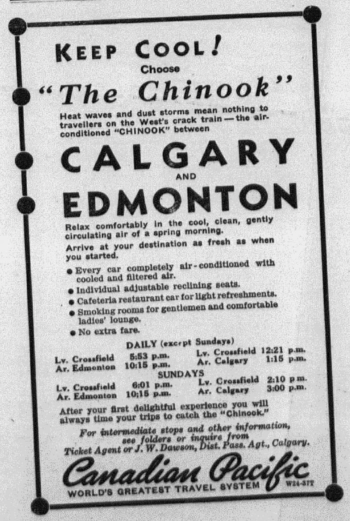
Passenger trains have also completely disappeared from Cape Breton Island, Prince Edward Island, the Gaspé Peninsula, and Vancouver Island. The east coast of Vancouver Island was served by self-propelled Dayliner railcars, on the old Esquimalt & Nanaimo Railway, a line built by coal baron Robert Dunsmuir. (Though service there ended in 2011, the Island Corridor Foundation, jointly owned by 14 First Nations and five regional districts, is energetically campaigning to bring trains back to the 289-km Victoria–Courtenay route.)
One of the most flagrant erasures of rail service happened in Alberta, a province whose population has now topped 5 million. (The Calgary region in particular is growing fast, with an estimated population of 1.84 million in 2025, 150,000 of them arriving in the previous two years.) The only inter-city passenger service of note is Via Rail's The Canadian, which crosses the province on its way from Vancouver to Toronto and back, following the old northern transcontinental route of Canadian National's Super Continental, by way of Edmonton and Jasper.
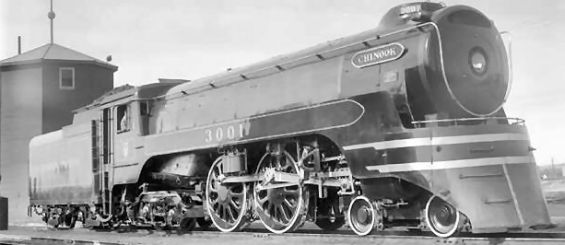
This was not always the case. Within living memory, Alberta was served by two transcontinentals. That's something I can testify to, because I remember riding The Canadian; my family relocated from British Columbia to Alberta in 1978, crossing the Rockies by way of the southern route—the original Canadian Pacific transcontinental—to disembark (ahem, detrain) in downtown Calgary.
Keep reading with a paid membership
HIGH SPEED is entirely reader-supported, with no ads and no AI slop. A paid membership unlocks this dispatch, every new one, and the full archive, and pays for the train tickets that make the reporting possible.
Rail Pass Holder
Full access to all dispatches, and the archive
$7 / month or $70 / year
- Every weekly dispatch, in full
- The complete archive
- Comment and join the conversation
- Behind-the-scenes on my latest book about riding Canadian trains
Founding Member
Help build HIGH SPEED from the ground up, and ride first class while you do it.
$10 / month or $100 / year
- Every weekly dispatch, in full
- Comment and join the conversation
- Complete access to archives
- Your name, and thanks, in the acknowledgments of my next book!
Already a member? Sign in