There are no ads on the HIGH SPEED newsletter, and there never will be. It's entirely supported by readers like you. I publish it on Ghost, because I don't like the way Substack platforms Nazis, fascists, and white supremacists. Unlike Substack, though, Ghost charges an annual fee. I want to keep HIGH SPEED going, but to pay that fee and continue doing the research, travel, and writing necessary to keep this up week in, week out, I need your support. I hope you'll consider becoming not just a free subscriber, but a paid member. Your subscription will help me keep this train rolling; you can follow the link to the sign-up portal here. And to all those who have already helped out by becoming a Rail Pass Holder or founding member, thank you!
// My plan to ride every passenger train in Canada in a single year, which I announced in this post, continues. Last month I rode VIA Rail Train 601 from Montreal to Jonquière.
It's a train I really should have taken many years ago. I've lived in Montreal since the mid-1990s, after all, and I knew that, in addition to the Halifax-bound Ocean, which I write about here, and the frequently-scheduled corridor trains (which leave for Toronto and Quebec City, described here), a passenger train departed from the city's Central Station for more remote destinations in northern Quebec three times a week.
Spring break at my sons' schools provided a good opportunity to try out the service. I planned a three-day getaway, with a hotel stay in Chicoutimi, in the Saguenay River region. I've been there before. One of my first experiences of Quebec was exploring this region after the catastrophic floods of 1996, on assignment for Canadian Geographic and L'actualité. I have fond memories of the kindness and hospitality of les bleuets, as the inhabitants of the Lac St-Jean region are known (the shores of the vast lake are lined with blueberry fields). Covering that story, which took me to riverside neighborhoods and villages that had been hard hit by the rising waters, had forced me to rent a car. Since then, the region's two major cities Chicoutimi (pop. 69,000) and Jonquière (pop. 60,000) have been demoted to boroughs of the new amalgamated city of Saguenay, which includes the town of La Baie. The new conurbation, like so many communities north of the St. Lawrence, is sprawled out, and sparsely served by transit, which meant that I'd made the painful, for me, choice of reserving a rental car to use once we got to Chicoutimi.
Our journey began with the ritual of an early-morning line-up at the Central Station in Montreal. I counted two dozen people in the queue. According to the big digital board overhead, we were scheduled to board at 7:15 am, but that time came and went, as did 7:30 am. Finally we shuffled towards the escalator leading to the platform, where VIA Rail attendants in dark parkas directed us to Train 601. Our final departure time was 7:42 am; a twelve-minute delay in leaving, which would have caused a Swiss or Japanese rail operator no end of shame, is actually pretty good for VIA Rail, and well within the margin of error I build in when I'm planning any rail trip in Canada these days. Besides, as day-trips go, this was a pretty significant one: we were scheduled to arrive in Jonquière at 6:50 pm, which meant, in theory at least, we would be able to make up time over the course of the 510-kilometer and nearly twelve-hour trip.
We would also be plunging into a wintry landscape: the temperature in Montreal that morning was -19 C—the weather app told me it was a few degrees colder in Jonquière—and snow would lay thickly on the ground for the duration of our trip.
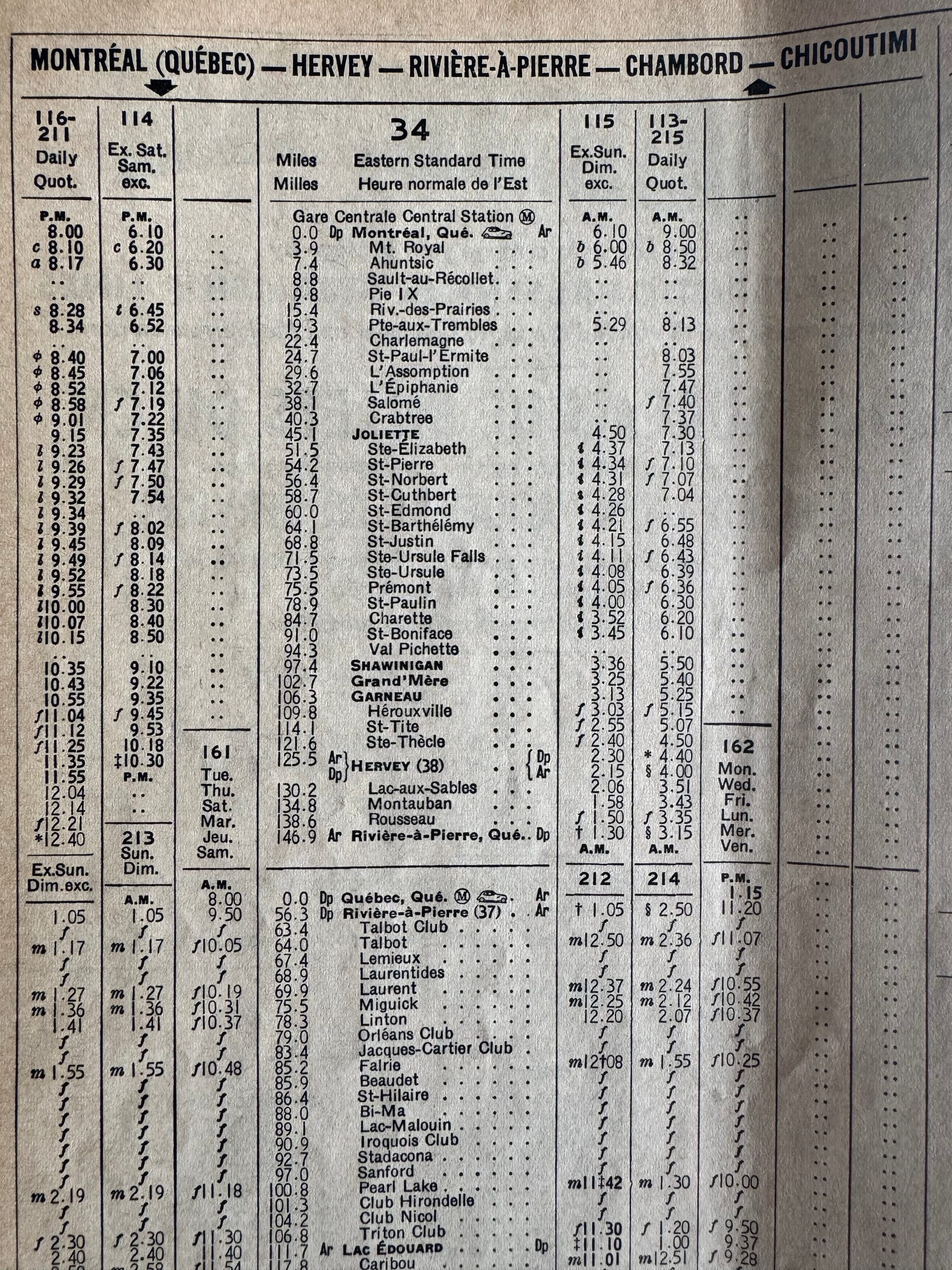
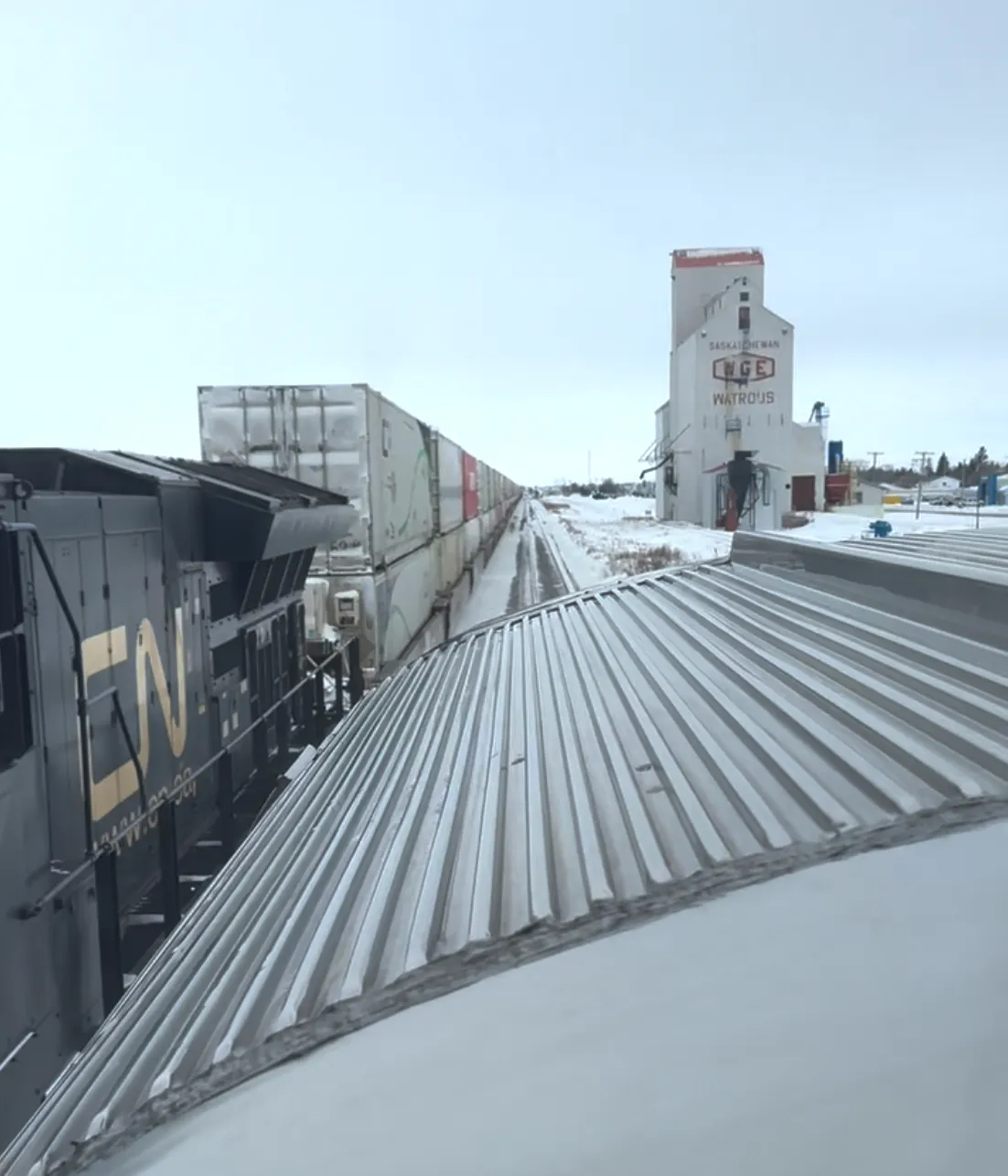
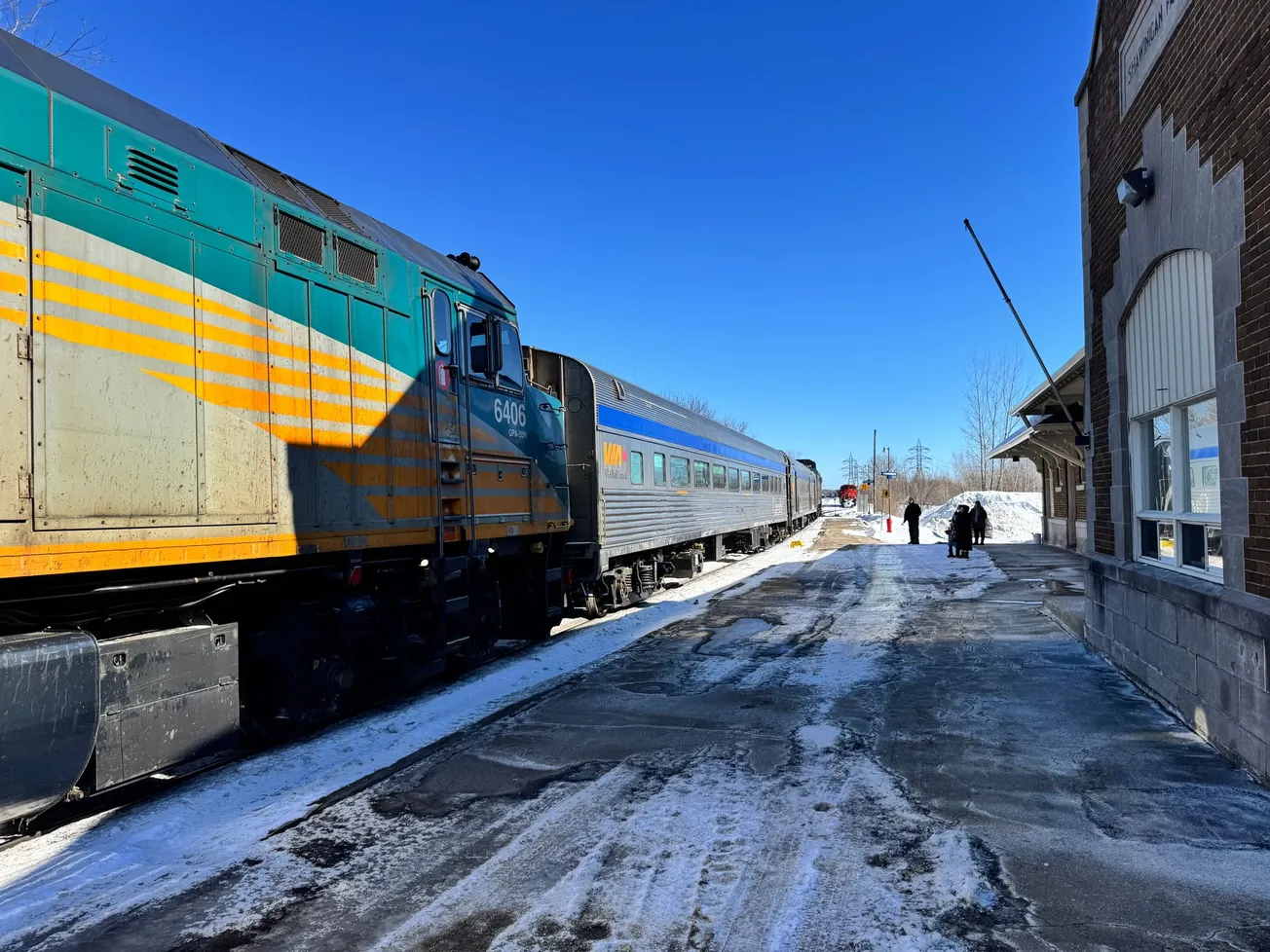
We boarded a strange train. When Canadian National Railways ran this service, two separate northbound trains made daily departures from Montreal. (Above is a CN schedule from 1963, showing four daily departures.) VIA Rail has chosen to combine the trains into a single service, which means that not one but two trains, conjoined into a single consist, were waiting for us on the platform. Passengers heading towards the village of Senneterre, in the Abitibi region of western Quebec, were directed to Train 603, which consisted of a locomotive pulling a baggage car and a single economy passenger car. Immediately behind the latter was Train 601, which consisted of a baggage car, two passenger cars, and a locomotive. (For those keeping score: it was Loco number 6406, a GPA-30H diesel-electric, which is a rebuilt version of the F40PH-2D, originally put together by General Motors Diesel, in London, Ontario.)
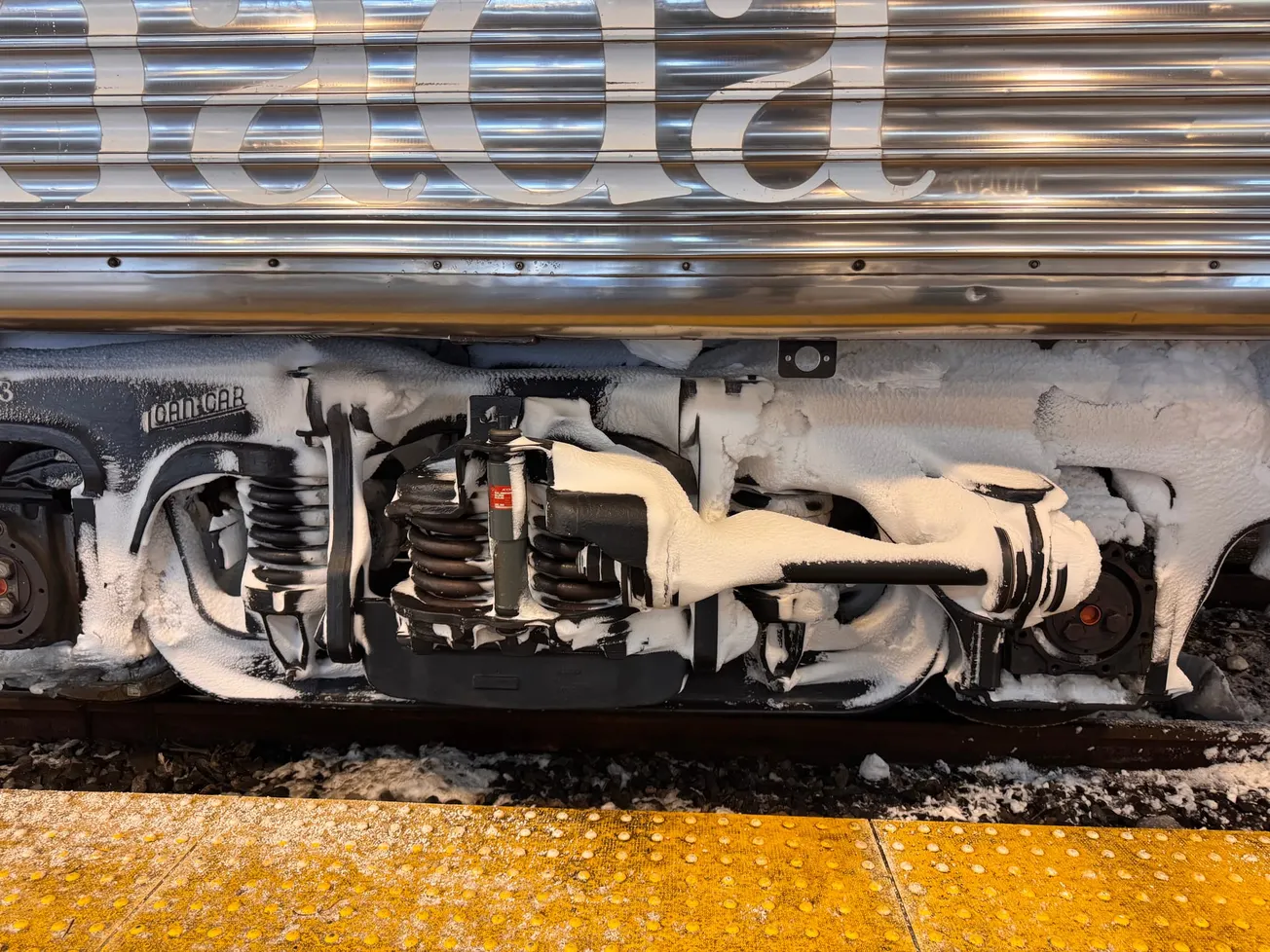
There were no assigned seats, so my sons and I entered through the first passenger car, and, after a quick survey of the seating arrangements, opted for the trailing car. A lot of people bemoan the relative antiquity of VIA Rail's rolling stock, but I'm always happy when I know I'm going to spend the day in one of the stainless steel streamliners built by the Budd Company. They remain the backbone of VIA Rail's long-distance fleet; the Manor and Park Cars I rode in on the cross-country Canadian in February were all Budds, built in 1954-55. The Budd factory in Philadelphia built warplanes in the Second World War, and these trains call to mind the gleaming, sleek styling of aerodynamic B-29 bombers.