There are no ads on the HIGH SPEED newsletter, and there never will be. It's entirely supported by readers like you. I publish it on Ghost, because I don't like the way Substack platforms Nazis, fascists, and white supremacists. Unlike Substack, though, Ghost charges an annual fee. I want to keep HIGH SPEED going, but to pay that fee—which I'll need to do early in 2026—and continue doing the research, travel, and writing necessary to keep this up week in, week out, I'm going to need your support. I hope you'll consider becoming more than just a free subscriber, but a paid member. Your support will help me keep this train going on. And to all those who have already helped out by becoming a Rail Pass Holder or founding member, thank you!
// There is a lot of movement in the world of Canadian urban transit these days, and that's good news. This week I'm in Vancouver, where the Broadway Subway, a five-station extension of the SkyTrain Millennium Line, is under construction, and is due to open in 2027; Mark V trains, more spacious and with capacity for strollers, bikes, and wheelchairs, have been in service on the Expo Line since August. This week, the Finch West LRT, the first new transit line in Toronto since 2002, finally opened. (The joy was somewhat muted when commentators observed that these streetcars—which is what this LRT is, a new, multi-billion-dollar streetcar line, but without the signal priority that tramways in Europe are afforded—actually ran slower at many points than the crosstown buses they were replacing.) We also learned that the long-delayed, hugely over-budget Eglinton Crosstown should be opening in the next few weeks. (It's been under construction for 15 years, which led a comedian to hire a mariachi band to hire a mariachi band to celebrate its quinceanera.) The Finch West opening provided the occasion for the administration of premier Doug Ford to congratulate itself on "delivering the largest transit expansion in Canadian history."
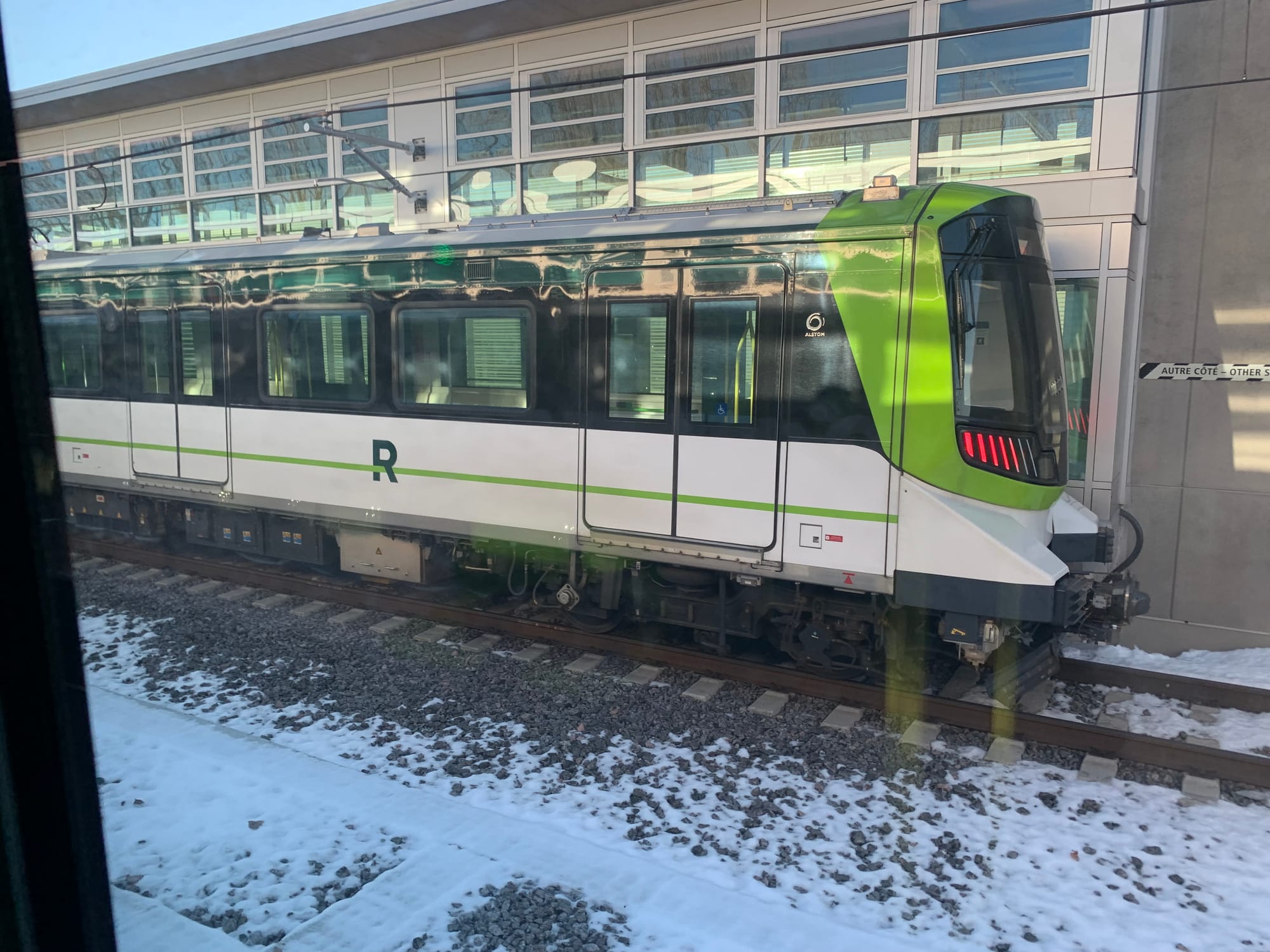
Whoa, là!, as we say in Quebec. While it's true that there is a lot happening in the world of transit in Ontario—an expansion and electrification of GO commuter trains, new LRTs in Mississauga, Brampton, and Hamilton, the extension of the Yonge subway line north to Richmond Hill, and the construction of the Ontario Line—these projects are nowhere near completion, some haven't even broken ground, and it's an open question whether Ford will still be around to crow about delivering any of them. That's why I maintain the largest single transit expansion in not only Canada, but also North America, is the one actively coming on line in Montreal. (And don't forget that, by removing bike lanes, the Ford Regime is delivering the largest dismantling of a sustainable transportation network in Canadian history.)
In the last HIGH SPEED dispatch, I wrote about the experience of riding the REM, the Réseau express métropolitain, the light-metro which in mid-November opened 14 new stations, for a total of 19, on the thirty-kilometer line from Deux-Montagnes to Brossard. Montrealers have clearly been delighted by the opening of the new line, and there are a lot of reasons to be impressed. Attractive station design, with silkscreened glass, ribbed concrete, metal panels, and sourced-in-Quebec wood. Fast, frequent trains—headways of as little as 2.5 minutes, speeds of up to 100 km/h. And surprisingly good integration with the existing métro and commuter-rail network, helped by an easy-to-understand zone system, which allows you to use an Opus farecard (which you'll soon be able to put on your smartphone) to transfer between systems. As transit analyst Marco Chitti points out, with its ARTM, the regional transit planning and fare-collecting organization, Montreal now has the closest thing in North America to a Swiss-style Verkehrsverbund, or "public transport federation," which makes getting around cities like Zürich on transit such a breeze.